![]() |
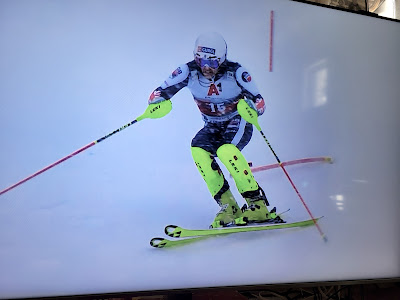
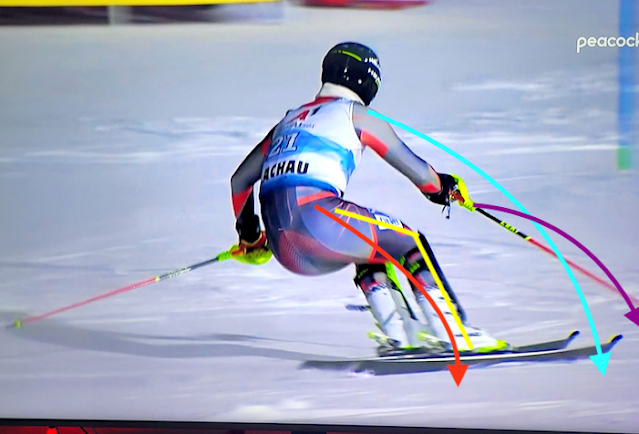
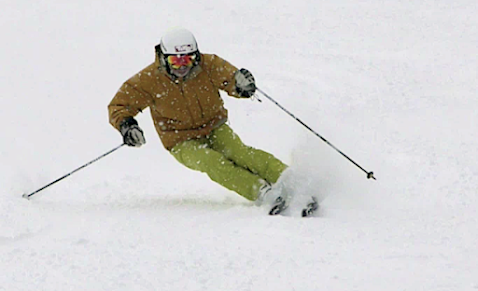
| Here Odermatt is well positioned coming under the gate ready to begin his movements to start the next arc. |
Harald Harb, President of Harb Ski Systems, posts his thoughts on skiing, ski racing, technique and more.
Tuesday, March 21, 2023
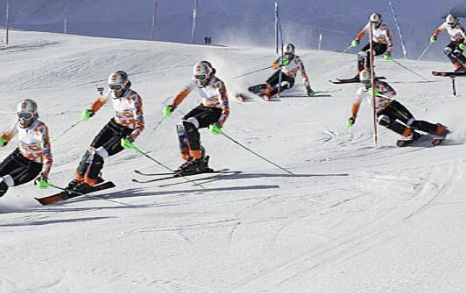
Different turns by Odermatt in GS.
Friday, February 24, 2023
Thursday, February 23, 2023
You won't fool yourself or cheat in "Pure Carved Turns" if you know this simple rule!
Thursday, February 9, 2023
Sunday, December 25, 2022
Power up your skiing using Richie Berger as a model!
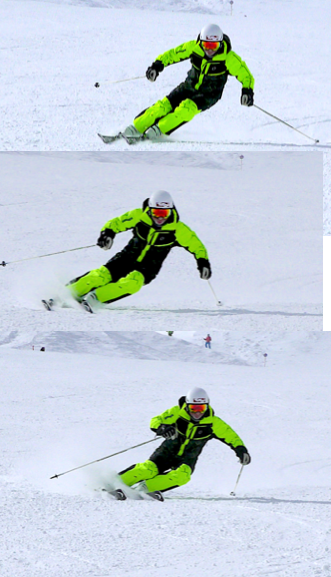
In this series of photos and with the text added, I explain the development of high-energy turns used by the world's best skiers. As with all PMTS skiing, the angles are developed through relaxation and inside foot, leg, tipping, and inside leg shortening, or bending.
In my Books and Videos "Anyone Can Be an Expert Skier 2 and "The Essentials of Skiing"; I explain in detail how this changes your skill levels and ability to ski all turns and terrain. The PMTS teaching System was developed well before either Richi, or Marcel Hirscher were known to me, however, they both ski perfect PMTS technique. My books were published before I knew Richi Berger or before Marcel Hirscher won his first World Cup race. Every movement and body change shown here is exactly as I have explained in my books, although my books and videos go into much more detail for learning these exact skiing traits.
With the energy stored in the ski and the potential rebound developed from the previous turn this amount of inclination is possible as long as you have the skills to stay balanced, which are described in the next frames. If your release timing is too late or your outside ski balance and angles aren't creating enough hold and carve, start your counterbalance earlier in the turn.
Here you can see how all great skiers increase counteracting and counterbalance as the turn comes to the finish. All world cup slalom racers show the same movments.The blue arrow demonstrates he has increased his upper body and hip counteracting. Notice that the pole tip has moved forward, his shoulders have leveled with his increase in Counteracting and Counterbalance. He is also starting to bend and relax his outside for leg shortening or bending to begin his release.
Notice that by the time Richie releases, his shoulders have come to level, and his hip counteracting is still held strong. This is the act of holding the CA and releasing the feet, knees, and skis for the transition.
Conparison: By the falline (skis pointed straight down the hill) there is a slight inclination in my turns as well as Richie's. However, if you understand the difference between dumping the hip into the arc first, verses tipping the feet, ankles and skis first, these two frames clearly show the result of the knees and legs moving first that result in these angles developed.
Follow-up notes: Don't be fooled by how easy this looks. It may also look like the movements are subtle, small or require little effort or exaggeration. I can tell you from having worked on these movements for decades these movements are not subtle, they require full engagement and commitment.
Friday, November 18, 2022
Skiing at the highest level: How to Transition with Fore/aft Balance preparation.
The PMTS Transition as applied by World Cup racers.
A skilled coach will approach this teaching one small step at a time, skiing slowly. The idea at first isn't to produce a perfect turn. In fact, it preferable to not be concerned about the quality of the turn, it is more important to focus on the movements that create this transition.
Thursday, October 27, 2022
Leg and bone curvatures for skiers, greatly influence your edge holding ability!
One of the realizations we noted studying ski racers for 50-plus years and performing alignment assessments for 40 years is the differences in bone curves and how they influence skiing biomechanics.
For the layman all you have to do is look at this photo to see the curve in the shin; this is a high tib-fib varum. Few experts, even those that deal with anatomy or foot alignment like podiatrists, differentiate between this curve and the standard bowed legs. Both are curves in the shin however in skiing they have and should be addressed differently for optimizing boot setup or alignment.
In this photo, the knee mass is lined up with the ski edge rather than with the center of the foot. As the suits and ski pants became tighter in fit around the lower leg and shin, leg curves become more apparent. Not all shin curves are the same and they all affect your skiing technique and ability to hold an edge differently. You might even say that there is a certain predisposed natural selection for success based on an ideal leg curve for ski racing. Going back as far as Pirmin Zurbriggen, his high tibial varum was obvious to us and so was his skiing success, that correlation repeats itself with a high percentage of successful ski racers.
![]() |
| The biggest part of this curve is near the top of the shin. |
A perfect example is Erick Schlopy, a bronze medalist at the world championships. His high tib-fib varum needed no under-boot canting and only slight cuff adjustment. However, due to his rigid strong foot and ankle, our boot board modifications significantly improved his edging ability.
This type of optimization requires a complete assessment of all functioning moving parts that influence skiing. The ankle and foot lateral inversion and eversion movement capability and the ski boot's influence on foot/ankle movement included, including all of these measurements must be taken into account before adjustments can be finalized.
This is an example of the commonly understood bowlegged low-shin curve anatomy.
Thursday, September 15, 2022
Skiing with the emphasis on the inside half of the body to create movements.
Inside foot and leg Movements
PMTS Direct Parallel is the proprietary teaching system invented by Harb Ski Systems. It is built on the fundamental that the movements of the inside half of the body in a turn, build a turn and is the basis for modern ski techniques and efficient skiing movements. The post below on my Blog Spot demonstrates how the body is split and where movements that create great angles and carving originate.
Where you can find PMTS Direct Parallel Techniques
Starting with my book "Anyone can be an Expert Skier" copyright 1998, I described the inside foot movement called the Phantom Move. In my follow-up books, Expert Skier 2 and "The Essentials of Skiing" I elaborate on and dissect how the inside half of the body is moved so all levels of skiers, on any snow can achieve success.
Sounds simple enough, however, this is completely opposite to traditional teaching and when done in the right order with the correct movements it will completely change your skiing. So if you want to learn the modern ski technique, this is the only complete system in the world that has proven over 25 years and with thousands of skiers that it's a game changer.
PMTS Fore/Aft movements keep you ahead of the turn.
Single or double foot pull back are the keys to staying in fore/aft balance.
Every skier on the world cup has the ability to do Dolphin Turns. This is the most advanced form of "Two Footed-pullback. However, to teach this we begin with the easy first steps which are very effective.
I hear this advice from race coaches/ski instructors either in written advice, in videos, or on the training course, "Get your hips Forward". Yes, that would be nice, however, there are no "pull your hips forward muscles" in the whole body. Rarely does that advice get results that can be used turn after turn?
If you use a different approach that activates the hip forward result you can use it simply and quickly for every turn. This movement advice was also pioneered by Harb Ski Systems. We teach this at our camps using a progression with the "Foot Pullback" approach.
Starting this movement right at the release of the old turn sets you up for a good Fore/aft balanced turn every time. In the photo above you see Petra using this exact movement with both feet. She lands perfectly balanced and forwards on her skis. We teach this using a one-foot pullback at the beginning. With the approach you don't have to be an expert, all levels of skiers can use it and benefit from this movement series.
Monday, May 16, 2022
Build a turn with inside ski tipping movements.

![]() |
| Focus on the inside half of the body that creates the next turn. |
![]() |
| Here the black arrow is on the inside foot tipping movement that is the focus. |
Saturday, April 30, 2022
Friday, April 22, 2022
Thursday, April 7, 2022
Quick and powerful short turns!
Friday, April 1, 2022
Turn Timing and Preparation in very short turns!
When this pole prep isn't ready by the point where the blue arrow is shown in the red arc, the upper body swings quickly and detracts from ski angle, edge hold, and turn quality. Most skiers use too much pole swing because they drop the pole behind the body while dropping the arm and pole to the inside of the arc.
A strong inside half of the body is shown in this photo, which compliments the early pole preparation.
Tuesday, March 29, 2022
Saturday, March 12, 2022
Some short turns runs from this season.
Variations on short turns that will serve you well in all conditions.
Friday, March 11, 2022
Learning to apply World Cup skiing technique.
World Cup Ski Technique
The Release
Sunday, January 23, 2022
British Skier makes history! David Ryding wins Hahnenkamm slalom.
From a country with almost no snow, no mountains, and no winter, how does a man learn to ski with the best skiers from Austria, Switzerland Norway, and Italy? The answer is "plastics". Yes, as was the advice given to Benjamin in the movie "The Graduate", "the future is in plastics?" Ryding learned to ski on slopes with plastic bristles.
Is this win a shock, not really. David Ryding is no flash in the pan, he has been on a world cup podium before, at Kitbeheul in 2017, in second place behind the greatest skier in decades, Marcel Hircher.
By winning, Ryding set two records, he becomes the first British skier to have ever won a skiing world cup race. He is also the oldest man to have won a world cup race.
Let us take a look at how it was done. The Kitzbuhel slalom is a classic race that goes way back to the beginnings of downhill skiing. It is a tough hill under perfect conditions as it has sharp rolls and sidehills in it. However, in a snowstorm, that was almost a blizzard by the second run, things got very dicey as was evident by all the great skiers that skied out of the course, or hooked a gate.
Ryding skied beautifully and perfectly for that hill and for the conditions. He was fast, he was consistent and he was in total control. Every other racer had some mistakes or trouble trying to ski a fast line. Watching the race you would have thought everyone but Ryding was on a more difficult course with extra icy conditions. The best skiers in the world were flailing, with arms flying, skis going every which way, basically struggling on every turn. The top 5 skiers had major mistakes in the second run.
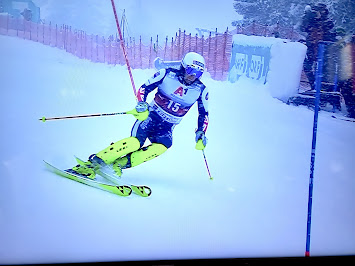
| David Ryding, a beautiful classic technique with great foot discipline and outside ski balance. |
Ryding skis with a narrow stance and great inside ski preparation and balancing movements.
Monday, December 20, 2021
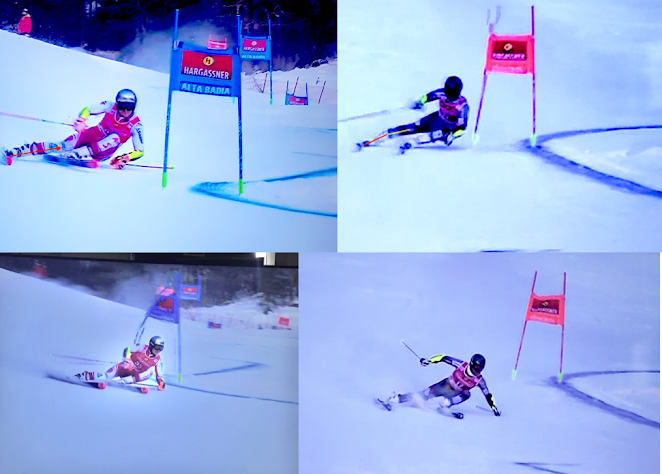
Consequences for World Cup skiers when cuff alignment isn't matching the leg curve.
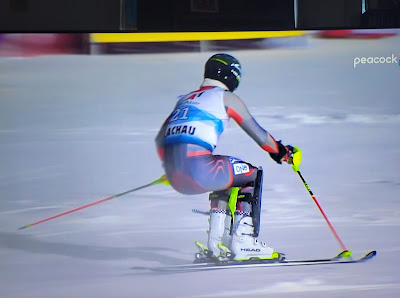
The top right photo shows the difference in ski and boot angle to the surface. There is a definite lack of boot angle compared to the leg and knee angle with the skier on the left. The consequences are shown in the lower right comparisons. Although this is a one-turn example, this occurred numerous times in the difficult offset turns in both runs. These two racers are on different boot companies.
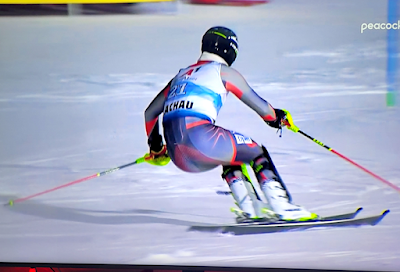
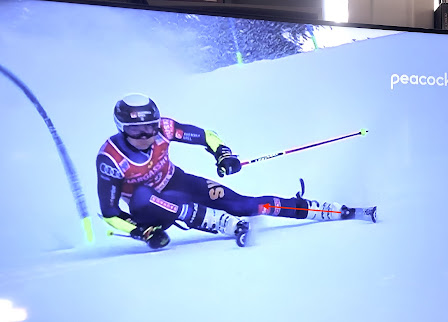
The photo below shows a new racer who put up an excellent performance with a good result, on the same boot company as the racer at the top right. Some racers obviously fit the manufacturer's
boot angles better than others, or the techs did a better job setting up the boots for the skier in the lower photo.
Saturday, December 18, 2021
Friday, October 15, 2021
The world's "Best Skiers" ski with the world's most efficient technique.
When learning to ski with “PMTS Direct Parallel” ™ you end up with the same technique as Hirscher. Without trying anything special and skiing my normal turns, the technical elements of these two techniques are exactly the same. I knew nothing about Hirscher or his technique when I wrote my books, “Anyone can be an Expert Skier” and the “Essentials of Skiing.” He is 29 and I am 71 in these photos. Hirscher uses the most efficient ski technique I have ever seen in my coaching career. With efficiency, you can ski for the rest of your life, with less fatigue, complete control, and more fun.