Sunday, December 16, 2012

Skiing the Little Toe Edge.

In the PMTS teaching system it is important that skiers are introduced to tipping and flexing the inside leg. We teach this to intermediate skiers because it works. Tipping the inside leg also raises your level of skiing because you become more efficient at transitions and letting go of the outside ski. 

Here Ted is slightly airborne, and the first ski edge he'll use to balance on when he lands, will be his inside ski, little toe edge. When he lands, his inside ski will create the Super Phantom Move, (riding the LTE) helping to start his transition.

Notice Ted's Arm position, recreational skiers take note, this is rarely seen by skiers on the slopes. It seems to take instruction to get people to hold their arms out to the side. It makes a huge difference in your balance. Racers take note, it's not about keeping or getting your arms forward, that advice just blocks your upper body from contributing to lateral balance. Get your arms wide and to the side, with the inside arm higher and more forward, when you can.

Head Ski Company has the GS skis dialed.

Ted Ligety is skiing better than ever, his technical disciple has improved, yet he has a big advantage with his equipment. Compared to many of the skis his competitors are skiing; his skis hold on the steep, ice, better.
If you watch the racers at the Alta Badia GS race, it's obvious the skis Head is making, are superior.

World Cup skiing getting more classic: Increased Counter Acting with top GS racers.


Of all the Essentials in Skiing
 "Counter Acting" has definitely increased.

Pinturault shows perfect form with his leading inside shoulder, hip and arm.
Felix Neureuther has found a new event with his great 2012 GS skiing.
Hirscher continues his steady skiing with another podium.

Saturday, December 15, 2012

World Cup GS technical comparison, Ted Ligety's weakness starting to show up again.

Marcel Hirscher
 Some may want to call Ted Ligety Mr. GS. But the season is just beginning. As we remember last season, Ted was great on the easier slopes and courses, but when it came back to Europe, Hirscher took over. So what do you call Hirscher, "Mr Super Skier"?  Hirscher not only won the GS crown last season, but the overall World Cup.


He has been on every GS and Slalom podium this season. Technically he is more solid than Ted. Ted is still making mistakes and it's due to his inside foot use and his hips being back behind his skis in many arcs. He continues to be on the verge of Balance failures, which cost him the race in Val d'Isere. Hirscher continues with his perfect, compact body, inside leg lifted and his outside knee right up against the inside boot. This makes the skis carve and fast.
Hirscher's inside foot rarely moves forward in the critical part of the arc. A great aid for keeping all the pressure focused over the center of the outside ski.

Compare the difference between the two skiers here. Ted is on his inside ski and also in the next frame less balanced than Hirscher. Obviously this is one turn out of 50, but this pattern was consistent and  undeniable as the difference between the two throughout the course. 


Ted Ligety compared to Pinturault. Ted more leaned inside and hips further back, as he does in slalom. Ted already too extended for this part of the arc.
With Pinturault you see similar compactness as Hirscher and the hips more forward and more lined up with the outside skis boot.
Pinturault is the more dangerous challenge to Hirscher, he's a more solid technical skier than Ted. My guess is we will see Ted's performance drop as the season continues, like last year,  and these two, Hirscher and Pinurault,  will battle it out for the World Cup..

Tuesday, December 4, 2012

What Ted is doing better than before.

      If you want some background and perspective go down and read the previous post.
 Here are examples of what Ted is doing that fit right into what we teach in PMTS Direct Parallel.

Counter-acting: His inside hand and shoulder are leading the arc. His torso is counter acting.

Counter balancing: His upper body is laterally balanced reducing inclination.

Flexing and extension: Inside leg totally flexed and bent. Outside leg long and solidly aligned.

Fore/aft: His hips are forward of his boots earlier and higher in the arc, without using an extension or up move of the hips.

Many can see that the outside leg is long, but that's not the issue, the issue is how does one get into this movement pattern. It's not a position! The only way to learn to ski this way is to know what movements are being used to create this kind of skiing. Few know the movements. We teach these movements in our PMTS system.

Ted Ligety's technique explained!

Ted Ligety
Everyone who watches the world cup knows Ted Ligety is dominating GS. The second GS race of the year was closer, under 2 seconds, but still a huge margin.

So what is Ted doing the others are not?

 Well, first he's doing what I have been advocating for years, his stance is much narrower in transition than last year. I saw this happening in his training earlier this season before the WC season started. He then collapses his inside leg more quickly then any of his competitors. This means his inside leg is tipping and flexing really quickly, into the apex or belly of the arc,  which drops his hips to the snow at the precise moment to gain huge angles. These perfectly timed movements engage his skis and create instant pressure and a shorter, stronger radius than the rest of the GS racers.

OK, that said it sounds easy, but if it were everyone would do it. Ted has practiced this for months and has focused on these details. He may not even realize what he is doing, but he has the sense of timing and angle creation that no one else has. Eventually the others will figure it out, but for now he still has the movements that give him the advantage and amazing confidence that his equipment will keep him up when he makes those incredible movements..

Check out his narrow stance, this is as close as I could find a photo, in transition, before pressure is loaded. This is a Super G photo, so notice the difference in stance the last few years. The racers are going to narrow up their stance, even more and use inside ski and leg tipping and flexing more precisely, then before.

Canadian Ski Team in 1970

This is the Team I was on in 1970, I'm third from the left, laughing at Rato's antics. Derek Robbins 2nd from the right, sent it to me. Derek is an Olympian. 
Other team members in this photo, Peter Duncan, Russel Goodman, Rato Barrington, Paul Carson, Doug Woodcock, Aiden Ballantine, Mike Culver, Peter Goodman. Derek Robbins.

World Cup technique for everyone, basics.

Marcel Hirscher
There is so much to be learned from this one photo. What I see and hear all the time from coaches on the slopes: Get your arms forward? Not the right message! Get your arms wide and feel the lateral body relationship to the forces to balance better. Notice how light the skis are on the snow, this is the High C part of the arc, no pressure needed here so the skis are tipped, but light. Tipping and creating angles is the right thing to do in the High C part of an arc.

Old friends from Canadian Ski Team racing days.

Bob Caladine, PMTS accredited instructor, was Canadian Ski Team.
 Bob Caladine, ex-Canadain ski team, from BC, slightly before me, but we raced together when I was a junior.
Jacque Roux, former ski team,  from Montreal, we were in the same ski club, Mt Plante.

Saturday, November 24, 2012

Marcel Hirscher skis PMTS

Marcel Hirscher
Lift and tilt the ski to release, inside little toe edge tipping first.
 At the end of an arc he's releasing his skis forward, flexing to absorb the energy and about to transition (change edges).
         
                       
(This is not the same turn as above) He has changed edges, pulled his feet back,  his tips are on the snow, his tails are lifted. Contrary to what many coaches tell their athletes, he did not raise or move his hips up or forward. This is a pure pull back move, as taught in PMTS and that is demonstrated in the Essentials DVDs.

Friday, November 23, 2012

PMTS Movements are the same as World Cup Skiers movements.

When you learn PMTS, you will be using the same movements as the best skiers in the world and therefore; you will raise your skiing level and performance accordingly. I often demonstrate the movements using photos and videos of the world's best, don't be intimidated, many intermediate and advanced skiers have learned how to ski with the this fabulous technique. At our camps we teach  exactly these movements. When we teach them in PMTS; we introduce movements in small bits and at the levels you can perform successfully. The tempo is slower, the dynamics are lower and the angles are smaller, however the basic movements is the same. Here is an example of a World Cup skier using the PMTS, Phantom Move release.

 This is Reinfred Herbst of the Austrian Team, he was the best slalom skier in the world in 2009. Beset by injury and equipment problems in the last few years; he has made a comeback this year and placed 6th in the first slalom of the new season.

You can see that in the top photo he lifts his old stance ski, at the tip. Next (below) he pulls the ski back and tips it toward the new turn and to the little toe edge. This helps his hips to cross his skis, and it prepares his edges for the new angles.
This is only one step or exercise you will learn with  PMTS. With the combination of movements like this, in a very short time, your skiing begins to connect turns with less energy and more control.

Notice the angle of the lifted foot's,  shin bone,  is more angles forward in the lower photo. Also the foot is further under the knee. This is a result of holding the foot back and keeping the ankle flexed and engaged.


Thursday, November 22, 2012

Super Phantom Move, by Harb Ski Systems, used by World Cup Skiers.


Look at the third, middle frame, he's standing on the little toe edge at the end of the arc.
One of the key moves taught in PMTS Direct Parallel, is the Super Phantom, which means transfer to the uphill edge of the inside ski at the end of an arc. This is accomplished by, reducing the pressure on the outside or stance ski by flexing the leg and or retracting that leg. This causes a release and a strongly balanced entry to the new arc.

Wednesday, November 21, 2012

Top US under 18 year old.

This is Nick Veith one of a group of strong under 18 years olds in the US Ski Team program. We work with him to set up his boots, He's on Dodge boots. You don't have to look hard to see amazing flexibility in his hips. 
Nick has been skiing out of the Steamboat school program, his Dad, Alan is an old friend and is Nick's main coach. We skied together years ago. Alan is a strong skier, French "B" Team.

You can see the influence of the strong upper body, Counter Balance and Counter Acting. Inside hand forward, outside hand very relaxed, not pushing or driving. Ski angles are amazing. In today's world of world cup racing, it's no longer about achieving angles, everyone can do it, to extreme levels. It's about fore/aft balance.

It's also about running a clean edge without hard pressure, in-other -words, tipping the ski early and increasing the angles as the turn develops. You don't want any hard quick edging movements. This means you can't twist the ski or un-weight it in transition to let it drift very far. This incurs a late and hard edge, as we saw in Solden those skiers went out of the course. Transition should be continuos untipping with retraction and engaging tipping movements with the lower body, before the apex or falline.

It also applies to slalom, a softer early edge is faster than a hard late edge set, Deville is the master at going straighter than anyone and still staying relatively evenly pressured. I'm predicting some wins for him this year, in slalom. I thought he could do it last year, but he's looking even better this year.

Tuesday, November 20, 2012

I am a big fan of Korean Skiing.

These are excellent turns, and excellent demonstrations,  however it is not "PMTS Direct Parallel" skiing. Why?


 I am a big fan of Korean and Japanese demonstrators and skiers. I coached Japanese racers in the 70ies,  my years as a racing coach. I coached one skier from Japan, who finished in the top 10, in two different Olympics slaloms.
I like the skiing, it is precise, more so than North American skiers and demonstrators. However, it's missing two things to be PMTS skiing. If you look at the top of the arc, the tails of the skis are slipping or showing some pivoting. It is very well controlled and I am not criticizing it; because it is well done. 
Again, we strive to engage the skis, by that I mean in PMTS we work on creating an angle earlier in the High C part of the arc. The other thing is the pole swing. If you have watched my You Tube videos, you know we try not to swing the tip of the ski pole toward the ski tip. As in the World Cup today, there is almost no pole swing, this is more efficient and requires less movements. Other than that, there is some minor hip rotation in some turns, but in general this is excellent skiing.
There are great movements here; flexing is the most obvious, tipping with the inside foot/ski first, also holding the CA in many turns and Counter Acting at the initiation. Excellent stuff.

Monday, November 19, 2012

The World Cup stance, the narrower the better!

Since I speak German, I have the advantage of watching the EuroSport feed for World Cup slalom races. The commentary about the skiers is so much higher quality than Universal Sports with Lewis and Purino. They use former world cup Slalom Globe winners, not downhillers. The talk is consistently about the narrowing of the stance of World Cup skiers in slalom. I have not heard much about the Phantom Move, which besides the narrow stance, is very prevalent. Here is an example from two clips of Deville making the Phantom Move to begin his new turn.

This is from the Levi Slalom last weekend.
This is the Classic Phantom Move; I write about it in my first book, "Anyone can be an Expert Skier". Deville, is not the only skier in the top 15 of the world using this move, almost everyone in top 15 uses it.

I wrote my first book 16 years ago, if you had followed it then, you'd be 16 years ahead of ski instruction today. And maybe more because ski instruction still doesn't use, teach or understand the Phantom Move.

Very simple to understand and you can see it on my You Tube Videos, if you want it in action.
Lift or lighten the old outside ski, tilt the ski to it's outside or little toe edge. As you tilt pull the foot back and bring your ski boot closer to the new outside, pressured ski.
If you want to ski your best, use the movements of the best skiers.
This is it.

Sunday, November 11, 2012

First Slalom of the year Hirscher on every podium so far.

Marcel Hirscher
Great skiing.

 Hirscher 2nd today in Levi, by 1 tenth of a second, wins second run. Not often recognized, but a critical ability in a racer. This holding or pulling of the inside foot back, is common with the Austrians. It keeps his hips in a centered, forward driving position. It also helps to keep the outside ski slicing cleanly. When ever you see that inside foot too far forward, it means the skier is slowing, looking for speed control, rather than acceleration..

Wednesday, November 7, 2012

11 year olds should have world cup technique

Three different skiers from a group of 11 and 12 year olds, I started coaching when they were 6 years old,  all from California.
Sorry about the quality of the photos they are clipped from Video.
                                         They have become so technically proficient we talk mostly about line and fore-aft balance, the rest of thier PMTS Essentials are  pretty much squared away. It's really fun coaching these kids.

Counter-acting most misunderstood skiing movement.

Marcel Hirscher using counteracting movements to hold tail of ski on edge. 

If anyone thinks counter-acting is not an important part of skier develop, they are not seeing what the best skiers in the world are doing. Contrary to what the USSA and US Coaches Association would like to teach, Counter acting is not a "position" (USSA uses "the athletic position") it's a movement that never stops, just as tipping is a movement in a ski turn or arc that never stops.

Teaching counter acting to the sub-jr 4 groups is easy and effective, if you know what and how to teach movement. Just as tipping or creating edge angles doesn't just begin, then stop, it's continuous, counter acting is the same and the amount is appropriate to the needs of the arc. Without it, you get upper body rotation, less energy and less rebound.

Thursday, November 1, 2012

Amazing Marcel Hirscher at 16.

He could have made the top 30 flip in World Cup with runs like this. He has incredible power and strength for 16. Now you know what you have to shot for juniors.

Robby Kelly, Solid Technique will pay off.

With this kind of form, this young member of the great Cochran ski family has a bright future.
Here is another off-spring, Robby Kelly, from the famous US ski family, The Cochrans. Robby's first world cup start was at Solden. Robby is a super athlete, could have been drafted in both football and basketball. Shows amazing technique here in this GS Turn.

Can you pick out how many "Essentials of Skiing" he has in place?

 This is one of Lindy's sons. Tim was also on the US Ski Team, his older brother.

I knew the girls well in the 80ies, Lindy was still racing, skied on Yamaha skis. I tested skis for a week every year for 5 years with Marilyn (Cochran) Brown, World Champion in GS, and Chris, her husband,  at A-Basin in May. Barbara Ann was gold medalist in Sapporo was also with us. Even Todd Brooker showed up one year, to test, demonstrating his talents, I think he was 18 then.

Friday, October 26, 2012

Comments from World Cup Skiers

SÖLDEN is the beginning of a long tough season. GS will be a different event this year. Most of the skiers in the race have grown up on shaped GS skis. Now the new rules with more loose, larger dimensions have taken the technology backward, toward the nineteen eighties, 1980. Men's GS skis are now 35m length, 195cm. The reactions have been predicable coming from older coaches, who raced and coached with the straighter technology 30 years ago.

 Here are the valid comments from racers about the new skis.

1. Set up turn higher at the top of the arc.

2. More weight or all weight on outside ski.

3. Wider line needed coming into the gate.

4. Upper body more counter balanced.

5. Less inclination, more ski angle required.

Wednesday, October 24, 2012

World Cup Skiers speak out on 35meter radius GS skis.


  World's best skiers:

It’s not secret that straighter skis will require more work, that’s why the athletes are strained and fatigued after a run. Just watch the Hirscher interview!

You have to concentrate more pressure on the sweet spot, tip to a higher angle and stand on it.

Inclination and leaning, which you might get away with on a more shaped GS ski, now can’t be as easily implemented.

Some athletes say technique will change, not really.

Technique will become cleaner and more exaggerated toward older established fundamentals, such as Counter Balancing with the upper body. This is obvious while watching the top skiers. One other big change you are seeing immediately, is a narrower stance. This because a wider stance puts more weight/pressure to the inside ski, which will cause the outside ski to run straight, because it acquires less pressure. More dominate outside ski stance will become an advantage, although it always has, these skis require setting up the top of the arc with more outside ski dominance.

 Harb Ski Systems ahead of the realization curve: At Harb Ski Systems we have been saying this for years as the recreational skis got straighter and wider. So this is how discoveries from World Cup, support and substantiate what we do in our teaching and ski selection at our ski shop.

Monday, October 22, 2012

"High Performance Skiing": Best Skiing I've seen from Ted Ligety

High Performance Skiing! Ted Ligety Training for Soelden. This is the best skiing I've seen from Ted since Beaver Creek last year. No skivoting, much earlier high "C" engagement and no out of control inclination, which killed many of his runs last year. Notice the PMTS lift and bringing in of the new free foot to set up his tipping and balance. This is pure PMTS. He did not have this last year. The retraction of the old outside ski is key to this whole turn set up. It's the little things that make the big differences. Notice how his stance narrows up, with his free foot management. Free foot management, which most coaches don't see is the key. I don't know if Ted figured this out for himself or if someone has worked with him on it. This movement makes it much easier to stay Counter Balanced in the arc, and hold CB. This video clearly demonstrates CB, Tipping, inside leg flexing. Very strong demonstration of 3 important "Essentials of Skiing".

Saturday, September 29, 2012

How to achieve the "Tipping" you see in the sketch below.

Here is a video demonstration of "Tipping" and the movements that help create what you see in the sketch below. This clip is from my, "Performance Free Skiing" DVD, available to order from Harb Ski Systems.

Friday, September 28, 2012

Skiing with the world's best technique, means "tipping", your feet, boots and skis to a greater angle, than you would normally stand with on any slope. Most skiers never realize this, and are not taught it in traditional ski school. "Tipping" is the foundation of "PMTS Direct Parallel". Study this quick sketch I put together to grasp what tipping on a slope really means. All the best skiers and experts in the world "Tip" their skis like this. Harb Ski Systems teaches "Tipping" at every camp session.
If you are missing the next step in your skiing, this could be it. "Tip More and Tip often". Angulation is a body position, tipping is an action and a movement, that either continues to increase or decrease, in a turn, but should never be static in skiing.

Tuesday, September 18, 2012

Young Italian Talent: shows "Essentials" of PMTS in her skiing.

The best 13 year old skier in the world.
Counter Balance: upper body vertical 
                                      Inside leg well bent and tipped to the Little Toe Edge

Saturday, September 8, 2012

Training for skiing!

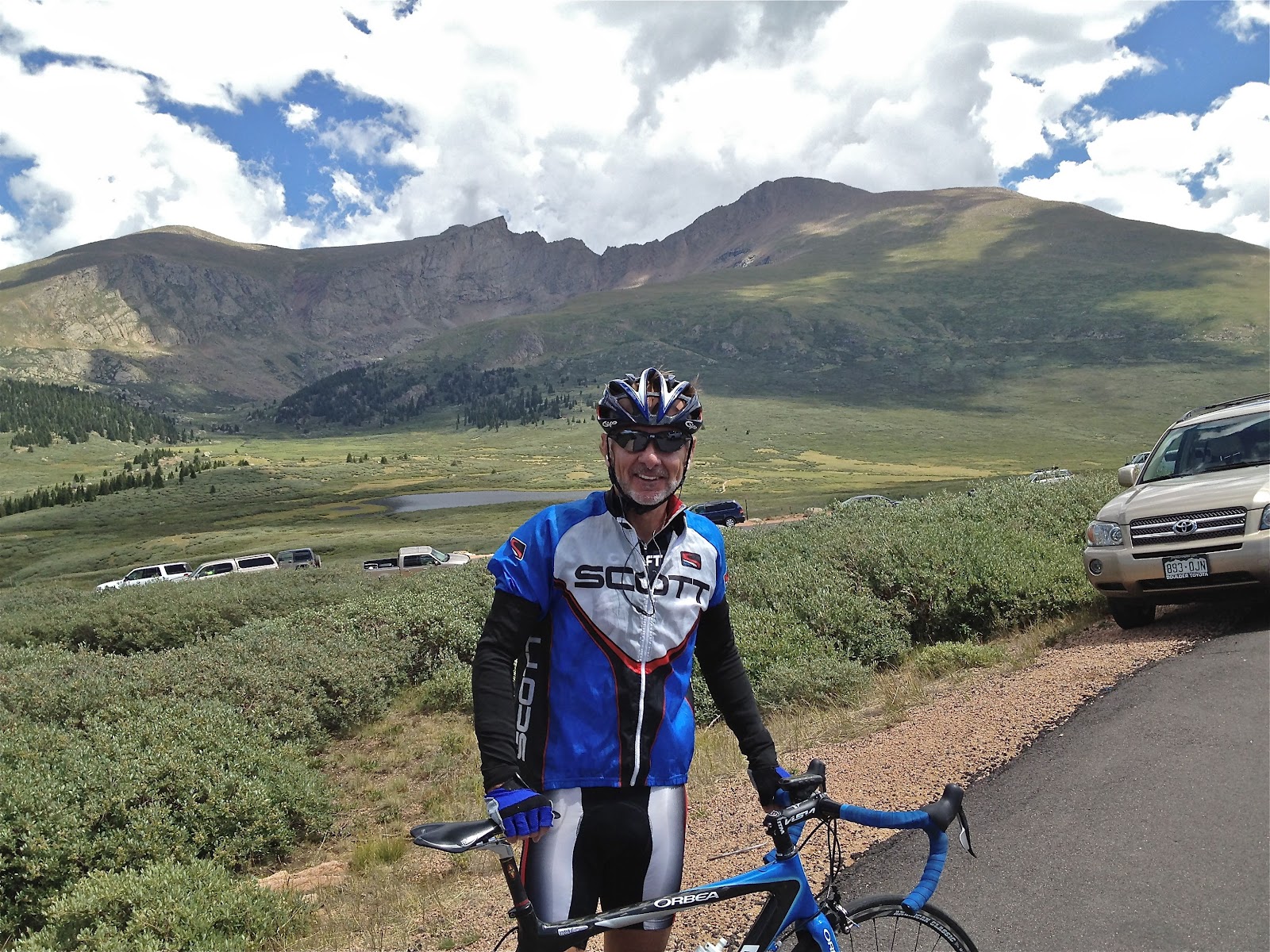
The ride 2 hours 3minutes, it was 45 degrees up there so winter is coming. From the shop, 4100ft of climbing, 22.5 miles, average speed going up 11.3 mph. Elevation at shop is approximately 8000ft.

Saturday, August 4, 2012

Putting in the miles and the time! Guanella Pass,

Guanella Pass (el. 3557 m./11,669 ft.) is a high mountain pass in the Rocky Mountains of central Colorado, US.

http://en.wikipedia.org/wiki/Guanella_Pass

                       4,700ft of climbing, in 1:20 minutes about 12 miles up, average 12mph.

Wednesday, August 1, 2012

Training, training, training, you have got to like it.

3 hours, 4100 feet of climbing, average speed 12 miles per hour, there and back. Twenty miles uphill.


Friday, June 29, 2012

What is the PMTS, "Direct Parallel Movement System?


PMTS, Direct Parallel, "The Essential Movement Based System".
Skiing involves the whole body, sometimes the whole body moves, and others times only isolated, regional, refined small joints move. Combining and co-ordinating these movements is what makes skiing fluid. We call it the “Essentials of Skiing”, using the PMTS  "Direct Parallel" system.
 The PMTS movement approach is unique in the world of skiing? 
PMTS teaches the same movements to a beginner, that are “coached” to top racers. The same movements used by the best racers in the world are PMTS movements. PMTS is not just a movement based “system”, it is the Movements of  skiing. 
PMTS movements are show-cased by the “Essentials of Skiing,  PMTS brings to the table a straight forward simple agenda of 5 “Essentials”. 
The 5 PMTS Essentials are, 1-Tipping, 2-Flexing and lengthening, 3-Counter-acting, 4-Counter-balancing, and 5-Fore-aft balance.
PMTS is straight forward, because it doesn't discard, reverse or eliminate any “Essentials” along the path to becoming an expert. 
With other systems you waste time learning maneuvers, that change, like wedges, wedge turns and wedge Christies, which you discard, to learn a different set of movements for parallel. With PMTS Direct Parallel, you learn the Essentials that you will always own as part of what you do as an expert. The PMTS system offers the same movements of skiing to all levels. 
As the skier's skill with each “Essential” increases, they improve the movements at each level. The formula has been perfected, skiers come away from each PMTS lesson, knowing what to do, even if they are not yet expert at the movements. Confusion is eliminated, confidence is gained. Knowing what to do, “exactly”, makes skiers successful, very quickly.

Thursday, June 28, 2012

Harrison Harb Wins White Mountain Classic bike race.


Looking strong in the break, Harrison comes in 10 seconds in front of 2nd place.

Wednesday, June 20, 2012

Climbing in our backyard.


This is literally 5 minutes up the road from our house. 
                                        Diana making the last moves to the top.
 We meet up with Richard Wright, a local icon of Colorado Front Range climbing. He is a prolific route developer and great climber.
                                    Diana and Richard top of Mill Creek Crag.

Friday, June 1, 2012

From the Book: "Essentials of skiing".

Marcel Hirscher, Overall World Cup Champion and GS Globe winner.
Hirscher demonstrates his means for holding the previous line, to set up his timing for the new gate. As soon as he senses he can accomplish his next arc, he flexes his outside leg and the arc begins. Here he holds a strong "Counter Balanced", hip and upper body. One of the Essentials of skiing.

Pole use: notice how there is no pole swing only a tap, from a CA upper body. This is what we have been teaching at Harb Camps for years.