Sunday, January 23, 2022

British Skier makes history! David Ryding wins Hahnenkamm slalom.

 From a country with almost no snow, no mountains, and no winter, how does a man learn to ski with the best skiers from Austria, Switzerland Norway, and Italy? The answer is "plastics". Yes, as was the advice given to Benjamin in the movie "The Graduate", "the future is in plastics?" Ryding learned to ski on slopes with plastic bristles.

 Is this win a shock, not really. David Ryding is no flash in the pan, he has been on a world cup podium before, at Kitbeheul in 2017, in second place behind the greatest skier in decades, Marcel Hircher.

By winning, Ryding set two records, he becomes the first British skier to have ever won a skiing world cup race. He is also the oldest man to have won a world cup race.


Let us take a look at how it was done.  The Kitzbuhel slalom is a classic race that goes way back to the beginnings of downhill skiing. It is a tough hill under perfect conditions as it has sharp rolls and sidehills in it. However, in a snowstorm, that was almost a blizzard by the second run, things got very dicey as was evident by all the great skiers that skied out of the course, or hooked a gate.

Ryding skied beautifully and perfectly for that hill and for the conditions. He was fast, he was consistent and he was in total control. Every other racer had some mistakes or trouble trying to ski a fast line. Watching the race you would have thought everyone but Ryding was on a more difficult course with extra icy conditions. The best skiers in the world were flailing, with arms flying, skis going every which way, basically struggling on every turn.  The top 5 skiers had major mistakes in the second run. 
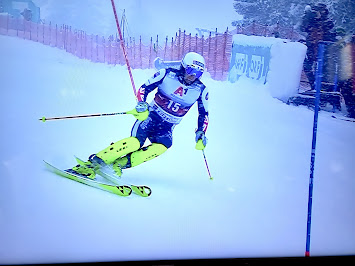


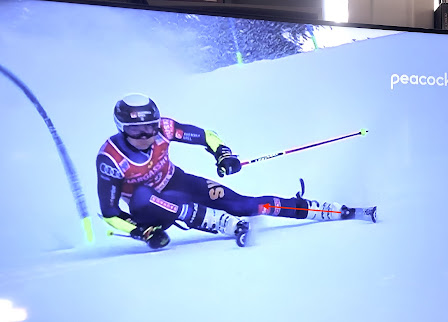
David Ryding, a beautiful classic technique with great foot discipline and outside ski balance.

Ryding skis with a narrow stance and great inside ski preparation and balancing movements.
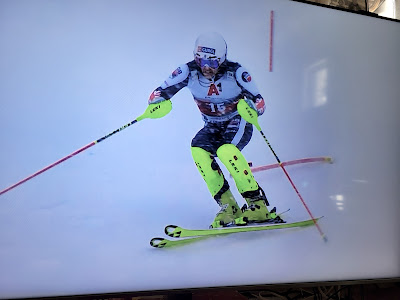

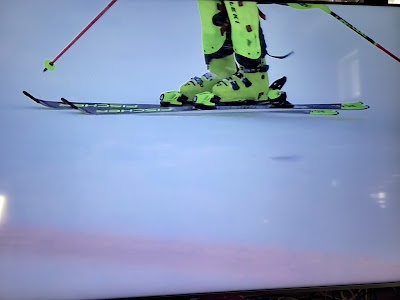
In this photo above, David retracts his stance ski, keeps his feet close, and prepares for this edge change.


This is a skill that served Rdying well on this undulating course, the foot pull-back. In this photo he prepares the new turn by tipping the new inside ski first and pulling the foot back to assure his fore/aft balance will be where it needs it for every turn.

These two movements are just 2 of the 5 "Essentials" that made a huge difference in Ryding's great skiing and victory at the Hahenkamm slalom.. They are well explained and demonstrated in my book, "The Essentials fo Skiing." There are 5 Essentials, and Ryding had a direct link to all 5 in his amazing skiing that won him his first world cup race.


Monday, December 20, 2021

Consequences for World Cup skiers when cuff alignment isn't matching the leg curve.


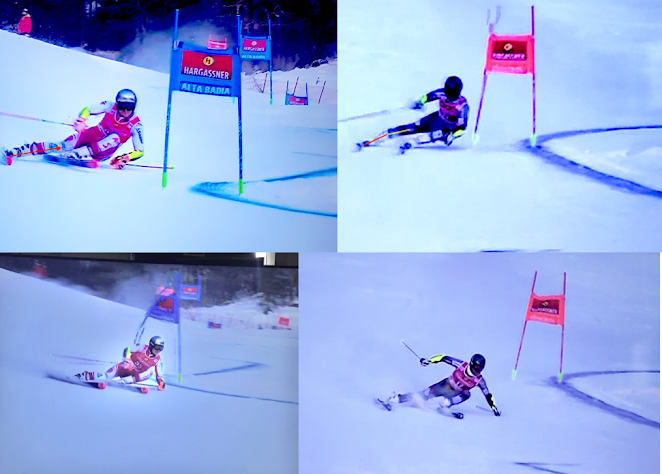
On the left is a newcomer to the top 5 in a World Cup GS race at Alta Badia. On the right is a veteran racer who has numerous top 5 results in his career but is now struggling. These comparison photos are two different turns, but the point isn't about the turn it's the leg to boot angles and the consequences. The times for the run support the result from what happened on all the turns where the racer on the right showed a lack of edge angle and ski edge holding ability.


 The top right photo shows the difference in ski and boot angle to the surface. There is a definite lack of boot angle compared to the leg and knee angle with the skier on the left. The consequences are shown in the lower right comparisons. Although this is a one-turn example, this occurred numerous times in the difficult offset turns in both runs. These two racers are on different boot companies. 


The photo below shows a new racer who put up an excellent performance with a good result, on the same boot company as the racer at the top right. Some racers obviously fit the manufacturer's
boot angles better than others, or the techs did a better job setting up the boots for the skier in the lower photo.


For the course set in Alta Badia, a racer needed to achieve an angle like the one above to make the ski perform well. Notice how the medial angle of the ski boot in this photo is touching the snow and the ski is at almost 90 degrees to the surface. This angle is much more in line with the top photo on the left which creates a turn that holds well and accelerates the racer down the slope.

Friday, October 15, 2021

The world's "Best Skiers" ski with the world's most efficient technique.


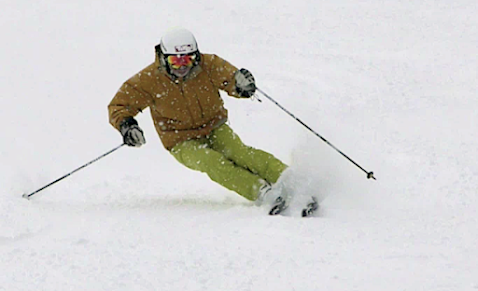
 When learning to ski with “PMTS Direct Parallel” ™ you end up with the same technique as Hirscher. Without trying anything special and skiing my normal turns, the technical elements of these two techniques are exactly the same. I knew nothing about Hirscher or his technique when I wrote my books, “Anyone can be an Expert Skier” and the “Essentials of Skiing.” He is 29 and I am 71 in these photos. Hirscher uses the most efficient ski technique I have ever seen in my coaching career. With efficiency, you can ski for the rest of your life, with less fatigue, complete control, and more fun.


Wednesday, April 14, 2021

Skiing April's light powder, Arapahoe Basin


                                                    https://youtu.be/PgBJzchAj8w


Saturday, February 27, 2021

Skiing traditions: Debunked and Explained! 1st in a Series, by Harald Harb

Just a short history: 

The transition in skiing has been misrepresented or not described correctly in ski literature since the beginning of time. In fact, in Warren Witherell's two books, it is never addressed at all. George Joubert, the French coach, in the late 60s and early 70s,  wrote two books. In them he does address the transition, however his descriptions are incorrectly focused.  I can make that statements because skiing at the highest levels has evolved differently from the way Joubert described it. Many so called ski technicians even today reference these books as the "gospel" never looking to evolve or properly analyze skiing after Joubert. Therefore ski teaching has stagnated since. 

In this series I will explain and break down how 21st Century skiing works at the highest levels and how recreational, intermediate and advanced skiers can add significant improvements to their skiing enjoyment and performance. With these methods and approaches you will ski with more efficiency, control and ease, rather than fighting gravity. You will learn to enjoy relaxation and the ease of acquiring ski performance with less effort. Let's get into it!

The Transition

The Transition is the most complex part of ski turns and requires the biggest change in the body. In the transition, your lower body, from below the hips, moves downhill, and the upper body stays the same until the lower body engages the skis to the new edge angles. Once this is done, the upper body needs to move from one side to the other over you skis. Ideally, this is accomplished without a pivot or and effort to create direction change. Once in the arc or a turn, the movements are relatively simple and consistent with how you stand on the ski. The transition is the point at which, everything happens, all this
changes and you move from one ski to the other and from one turn to the other. The best free skiers and racers can get this done before they reach the fallen. Let's have a look at the basics. 

     For the first session of body movements in this series; I focus on lower the body.       

To achieve a good transition, you have to have the skis engaged, not slipping, and the inside leg bent more than the outside leg. This happens with inside flex bending and tipping. Also, the upper body needs to counter-act the turning forces, called counter-acting. More on that later.


Through the bottom of the turn continue building your angles to load the outside ski. Many skiers give up the turn too early and therefore are rushed, therefore never getting the lower body released.


The actions of the release have begin already in this photo. The outside leg has shortened through bending  and lightening the pressure. How do you lighten pressure? You physically retract or pull the ski and knee up. Photo below.


The red arrow is the movement to retract. The blue arrow is getting that ski released.         The black arrow is where your balance and pressure goes when you create these     movements.


Now the tip of the ski is lifted, both knees are equally bent and the angles from the previous turn are gone.


The skis are flat, and half way through the transition. Notice nothing else has moved, only the lower leg flexing and bending up toward my chest,  has created the transition. Now both legs have the same amount of bend.

The lower body transition is complete, now you build the actions for the arc. The inside leg keeps bending and tipping,toward its outside little toe edge of the ski, until it is shorter than the outside leg.


The red arrow is for continued action of bending and flexing. The yellow arrows are
to indicate increased tipping.   Never push against the outside leg, common
error tau
ght to skiers.


In the turn, all is good.

Keep a look out for the second article in the series where I address the upper body responsibilities in transition.

Sunday, January 10, 2021

One of the 5 "Essentials of Skiing" Counteracting!

If "Carving" is one of the things you want to achieve in your skiing, then "Counteracting is a big contributor to that skill. In this post, I define some of the key ways to learn how to achieve and develop CA.


 The Yellow line curve is the arc of the turn. The two blue arcs are movements you make while in the arc, starting at the top of the arc and moving the arm and hand forward toward the tip of the ski until the end of the turn. 


Notice the ski pole tip is also moving downhill and in a circle as much or in advance of the skis coming through the arc. 


When you begin to learn how to use counteracting it may not work its way down to your hips where you see the red arrows, at first. (photo above)


This is difficult for many skiers to create hip CA due to either lack of awareness or flexibility. With practice, you can increase your hip support for your turns.


The forces in a carved turn want to rotate your torso, which decreases ski angles and edge hold. This is the reason to develop CA movements. Just trying to hold a countered hip isn't enough. Counteracting, or CA is a movement, not a position. 


Begin by using the pole tip, arm, and hand on the inside of the arc, to develop your CA movements through turns. Slow down, and pick a relatively flat slope to practice this. Make the movements from the top of the arc all the way to the end. This requires effort and patience, it won't happen immediately but it will pay off with great skiing if you stick with it.


Friday, November 14, 2014

10 to 13 year old ski racers, with superior skiing and mature technical development, Are Fast!

There are some notions and beliefs around US Ski Coaching,  that young racers who ski too well and have learned good technique; are never going to be successful fast racers, because they are over techniqued. 

Sometimes I have to just shake my head in wonder at the belief systems that prevail in skiing.


The notion that good technique makes you a slow skier is not only absurd, but it's an attempt to remove the responsibility of good coaching from the coach's back.  

When proper technique is coached and developed a young racer doesn't have to dwell on his skiing he can relax and ski fast without thinking. The individual and his personality traits bring the fire in the belly on race day. And if you don't have that fire naturally, you probably won't make it whether or not you have good or undeveloped technique.  It's the determination and motivation that makes a skier aggressive and an attacking racer, not diminished in the slightest by his ability to ski well.

 In fact, it's the opposite, the better you ski the more confidence you have to ski fast, not the other way around. Sometimes in the US we have strange ideas about what develops success.
In Austria all the racers learn to ski well and then they develop into champions, and they all  "amazingly" have the same good technique. Are they over techniques? Maybe they are but they are still fast.

Below are three very fast racers with exemplary technique. When taught correctly and without technical overload or jargon, skiers don't slow down to ski well in a course; they rely on the instincts trained into their skiing movements. 


In these photo you see skiers with world cup skiing. Outside ski, skeletal alignment to the forces and excellent balance.


 These skiers developed these basics through exercises skiing outside of gates. This requires focus concentration and discipline. This is often not something everyone has or brings, many skiers have to learn how to focus just as they have to learn different techniques.


(Below photo) This is 10 year old Zack, he's highly focused and loves exercises that he uses to  develop his skiing by training outside of gates.


A highly skilled skier always looks like they have world cup technique, doesn't matter what age.

Sometimes you have a wild and loose skier who needs to be gradually reigned in to develop enough technical ability, yet not lose that free spirited edge. Ever skier and personality is different and coaches need to realize you don't treat all racers the same way. The skier below is a free spirit, yet he now has the ski technique to also stay in the courses while skiing fast and free.

Saturday, November 8, 2014

Proper coaching results in excellent racers.

This racer is 13 years old, has been taught "How" to get to this relationship to his skis. This involves using correct movements into and out of the turns to accomplish a photo like this. These are world cup skiing techniques and body movements and angled relationships.  These types of movements are not taught by USSA education to coaches or by coaches using USSA training. This is a totally different system, much like what the Austrians use to create the best skiers in the world.


If what I stated above is the case, what are the key differences from what you see here and what is in USSA Coaches Education. The first glaring difference, if you listen and compare to USSA coaches education, USSA coaches education has no clearly outlined, "descriptions of the movements" or "how" to create the right movements to become top level racers. Yes, sure there are "concepts", but concepts don't teach coaches how to coach or racers how to move their bodies.

Second, there are glaring portions of a ski turn missing from the overall understanding of skiing in USSA coaches education.  For example: the transition, going from one turn to the next, is not described, no movements are appropriated to this most important aspect of skiing. The transition (between gates) in racing, is the part of the turn that has the most body changes, largest body movements and where American skiers most often have trouble, yet no mentions of this phase, in the skiing pyramid, hierarchy, for slalom. Also the transition sets you up for the next turn. If you listen to the  Sasha Rearick, US Head Men's Coach,  in his presentations, there no mention of a transition. No mentions of it's importance, how it's done, what movements are involved or how to set it up.

Another glaring omission, is boot, foot and ski tipping, how to tip a ski on edge, which ski to tip,  how to un-tip the skis and what movements are involved.

Mr. Rearick tells coaches in presentations that he will not tell them "how" to coach, or how to teach, or what to coach, they should use their imaginations. US coaches have been using their imaginations for decades, how is that working? Yet, the US ski team still complains that there are no talents in the development pipeline. How is it that the Head Coach of the Men's US Team after berating the US domestic coaches for not developing enough world cup skiing talents, can end the presentations with no help? He goes on to say he isn't going to tell them how they should coach, so how does he expect to get from domestic programs what he needs on the world cup. Does anyone else see a total disengagement of responsibility from a national team coach as an educator? If he isn't going to educate coaches, why is he presenting?

Tuesday, November 4, 2014


Pure example of missed boot set up. It's not working here either.


The article is a filled with incorrect approaches to boot set up.. The poor and misguiding information is coming out of Ski Racing these days is astounding, sensationalism reporting, without references, or facts. I was there when Warner put his back out in training at Loveland. I had checked his alignment on our stand at our shop numerous times. It was completely due to his "mis- alignment" of his boots, and he wouldn't listen to reason about his over canting. He over canted himself and he got hurt because of it, this was on his Dodge boots. Warner has little understanding of his or anyone else's alignment for that matter.
I don't know why Ski Racing Magazine can't write about proper correct alignment information, it is available. It would be much more helpful if Ski Racing wrote about alignment that is actually relevant to skiers, and at the same time is accurate?????? Perpetuating confusion about alignment doesn't serve the ski industry and can actually hurt people.


Anyone following this advice from Warner's article is putting themselves in serious jeopardy and the possibility of a serious knee injury. Warner should be ashamed of this article and his ignorance of proper boot fitting and alignment.

Warner's solution to tip his cuff toward his leg, it doesn't work the way he intended. It makes the boot highly over reactive to any terrain, ruts or chatters in a course. It also pre-loads the boot enough that any slight tipping force toward the new edge is over done and right after that the boot and ski drop excessively inside, so much so that the ski can't possible hold an edge. Although this may feel like you get tremendous grip when free skiing, in a racing situation it actually loads the ski early and quickly and makes for a very hard hit when it achieves early hold and is quick to the edge, and these quick re-loads shocks end up in the knee and lower back as the shock travels into the body.
A very dangerous situation.

Monday, October 6, 2014

Skier and Racer Alignment, it's not art, it's science.


Here are some examples of skiers 13 years old, with good alignment. There are 6 different skiers here, how lucky I am to have 6 different skiers with perfect alignment????? 

People think this is normal, they are all naturally talented and perfectly aligned. I have coached this group for 6 years and everyone of them has some adjustments under their boots. Every time they change boots we have to find the new optimal set up. This is done by on snow analysis and indoor measurements. Indoors to keep track of the norms, outdoors to test the skiers movements and ski angles. We sometimes change the alignment after each run, to test what works best. 
Every leg here is lined up perfectly with the forces. There is no undue stress on the knees or joints when alignment is correct. Skiing can be rough on the joints. At this age you would never realize it. One of my goals as a coach is to reduce as close to eliminating any opportunity for injury with every possible technical innovation. Alignment is one of those that is always addressed in our training.


Saturday, October 4, 2014

How the body changes with higher angles.

High Angles
Comparing subtle differences in how refinements can help your skiing. This is high level skiing, intermediate skiers may think this is nit-picking , however all of this applies even at the learning levels. And remember we never stop learning, wherever your level is now.

The most obvious difference to me is the outside arm, which effects the counter-acting, counter-balance slightly, and the angular momentum of the body. In the end, I think it affects the amount of adjustment you have to make at transition. If some don't see it, look at where the bottom of the ski pole is (the pointed end) in the different frames on the outside arm.

                                                                      Free Skiing (below photo)
                                                                   High Angles
The difference between free skiing and high angle skiing is inside leg bending or flexing and relaxation of the mid body to allow the hips to drop inside. Of course you have to feel like your skis are really hooked up to let go, and get down this far.

Friday, October 3, 2014

Ski Better, Learn faster, Find Success and know what you are doing, with PMTS tutorials.

Everyone wants to ski better, or eliminate your wedge in all ski situations, or link those turns smoothy. It's now available, not just tips that last for 5 minutes, true complete step by step video tutorials by the pros who are expert teachers, that invented "Direct Parallel",  "Anyone can be an Expert Skier" and the "Essentials of Skiing". Check out this page.
Ski better learn more, find success! Click on this link below:

http://harbskisystems.com/index.php?option=com_virtuemart&view=category&virtuemart_category_id=17&Itemid=102

Wednesday, October 1, 2014

Get my Blog updates in your E-Mail.

This feature is cool, just enter your e-mail, it will not be used for anything else, no spam, mainly because I don't know how. Just kidding, it's private. The only thing that will happen is you will get a notice of new posts whenever I put them here, immediately. 

PMTS Skier Development: The Transition in Skiing

 The transition is the most important part of the ski connection from turn to turn. It involves the biggest body change and movements in skiing. The transition takes you from one side to the other, a complete reversal of body line up. Once you understand this has to happen you can make it successful.  
In PMTS skiing,  the change happens before you enter the new turn and new falline. This is designed to make sure you are in balance and well organized for every new turn. Traditional ski instruction is different , they tell you to steer your legs and stand up, which forces you to struggle through the whole next turn to survive.

                           
                          (below)  Setting up for the last bit of inside leg flexing(bend or shorten)  and tipping (add more angle).

                         
  Now the arc is complete, I start to bend the stance leg (Shorten the outside leg) and transfer balance (weight) to the upper ski.


  The transfer to the LTE, upper ski, this is the "Super Phantom", it's clear that this is happening in this frame.

    (below) Here you see the balance transfer to the uphill ski.                          
     Hold your countered upper body through transition. If you give it up at this point, you will pivot the skis as they come flat to the snow. Pivoting loses the transition and the High C engagement is lost and the tipping can't continue. This is why a steering approach doesn't work to create high level skiing, it kills the transitions.
Release your stance leg to change edges, let both legs change edges, the new LTE, (new inside ski outside edge) for the new turn leads the way to develop new ski angles , not your upper body.
New inside foot pullback should already be happening, don't panic, by twisting your legs or steering.


 Both skis come flat at the same time. The upper body still has not moved, and it's still in the same relationship as it was at the end of the previous turn. If you square up here, you will not be able to get back over your skis without extending.
                             Hirscher uses exactly the same technique in slalom, as this demonstration.

Transition continued

The second part of a Transition is the engagement phase. Many instructors and coaches will say, "He's sitting back on his skis here."  

I'm just flexed from the previous turn. No panic, this will develop into a high "C" arc and a centered stance on my skis by the time I'm at the falline , where I need tip pressure. 

The Upper body still holds the Counter-acting from the previous arc.
I am still flexed, yet still tipping to the new edges. I'm light on my skis not extending no pushing against the snow to get grip. My outside ski has almost no pressure on it. I'm not driving my big toe edge or steering to get big toe edge grip. I'm letting my Cg cross into the next arc instead.

This is the point in the arc where traditional ski teaching totally screws you up. They want you to steer the ski here. All that does is, it keeps you Cg from crossing into the new angles. Steering keeps you hips over the top of your skis, it delays engagement, and doesn't develop angles.

Now my CG is across my skis and my outside leg is getting longer.  Now pressure is beginning to develop on the outside ski, no snow spray yet. My inside arm starts to move forward and down hill, my upper body begins to turn to face the outside of the arc.
Inside ski tipping increases, my inside foot and leg pull and hold my ski back, (from moving forward) my boot toes are lined up almost even throughout this phase. This allows my hips to move down and into the arc.
Below, obvious inside foot and leg tipping increased, still pulling the free foot back. My outside arm is helping to develop the Counter acting, as it prepares for the no-swing pole tap.

I'm centered and over my skis, completely Counter-acted with my hips and shoulders. All this without extension or up movements. Inside foot management and counter-acting develop efficiency and no need for drama. No push-off or wedge ski relationships, knee drive or steering needed. A completely different picture from traditional skiing.

                                           "Different movements create different outcomes."
There are two "Different" ways to ski, the PMTS way, which is the world cup way, or the ski instructor's way, which is the Demo Team skiing you see in the MA on this Blog, which I posted earlier this month.

Important summary note: As you read my last two Blog posts, and study the images, there is a key point in the "engagement phase", of the transition to note. I prefer to call the "High C" point, the "Engagement phase of a transition", because it's not really a new turn yet. This is a critical time and as I have pointed this out to numerous skiers and in numerous publications and videos, "If you square up at the release, you are doomed to pivot your skis in your "engagement phase". Why? 

If you look closely at the images and study the stability of my upper body, you notice that my legs change angles, under my hips, as do my skis and boots, my upper body doesn't move. 

In fact, if it does anything, it makes counter acting become stronger. The legs can release and you can transition more easily when the upper body stays facing the outside ski. 

If the upper body rotates toward the tips, faces the tips and the outside arm swings toward the tips, you can't release the legs. 


This is evident and demonstrated in the post I put up describing the skiing of the 4 Demo Team skiers from different nations. They all square up. And they all step or wedge out of the bottom of the arc. This is unavoidable, if you square up your shoulders at the end or during your arc, and use leg steering in the arc.
It forces the skier to step or wedge out of the arc, because when you rotate, a flexing release can't happen. 


Once you square up your hips and shoulders, the "force vector" changes from linear, to a rotational angular one, at the end or the arc. The rotational movement of squaring, creates angular momentum and reduces the outside ski's rebound and hold. When this happens a push is needed to get out of the turn. Any push at this point messes up the next turn.