Tuesday, September 30, 2014

Two "Must Have" Techniques: Refined Powder and Bump skiing.

                                                          Bumps and powder

Look for a complete tutorial on the topic of NO Swing pole plant from our web site EVideo store in the near future. The no-swing pole tap is an advanced skier approach that reinforces counter acting and ski rebound at the end of turns to energize the transition.

If you never want to look like you are working for your turns this is the answer.

The round turn in the bumps approach for speed control is tipping without turning or the Super Phantom Move.  This is explained and demonstrated in the  "Expert Skier" video 2, and in the Essentials of Skiing videos.


Friday, September 19, 2014

This is not your Grandfather's ski lesson.

This is PMTS Skiing, no hard edge sets, no wedge turns or wedge christie, easy on the legs and fluid movements from arc to arc. You can do this until you are 80.


Here I'm already released and in Balance, ready for the new arc, compare this to the skiers in the post below.

Thursday, September 18, 2014

This is not tipping, it is knee driving.

Why many good skiers can still improve. 


This is a good skier, but his technique is compromising him from becoming a great skier. 

He's driving the outside edge with his knee at the end of the arc to get edge hold or grip. This kills rebound from the ski; therefore an extension is necessary to get out of the arc. We do not teach this way of skiing in PMTS; this is a PSIA or instructor based skiing technique.

 This is a huge extension still taught in Traditional ski schools, this is one of the basic roots of dysfunctional skiing at high levels. PMTS does not teach an extension of any kind; we develop a long leg by tipping the feet and relaxing and bending the inside leg to tip the ski, we drop the hip inside the arc with flexing, which creates a long outside leg. With the PMTS approach you develop pressure in the arc by the falline, that can be used to release and send you to the next arc.  In this TT method of teaching, there is no pressure building in the arc,  due to steering, leaning, squaring up the hips, the result is huge knee drive, that is why you see all the hard edge sets at the bottom, with "A" frames and wedge entries to turns. This isn't tipping based technique, used by the PMTS movements, it's a Traditional Technique steering, edging and wedge turn technique.

 This is a wedge christie, we don't teach a Wedge Christie at any point in PMTS Direct Parallel. We teach Parallel from the beginning. Any skier at this level should no longer need this movement, it's due to the points I made earlier, it's due to steering, extension, rotation and leaning. These results are not intended by TT skiing, but they are however consequences of TT.

These guys are highly athletic and that's why they can get away with this type of dysfunctional movement. This takes lots of muscle strength, energy and hard hits on the body. That is why regular ski instructors can never learn to ski like this.
 Notice the hard hit this skier it taking, he's a good skier, but he's so late with his edge hit, to stop the skid he created by steering, he's buckling at the waist to absorb the shock.


 This is a wedge turn, I'm sorry, but if you use TT or PSIA, CSIA movements you will never lose your wedge. If you look closely, you'll see most PSIA examiners, Demo Team and DCLs all have wedge entires to their turns. Why, because they are using an antiquated technique that was never designed for shaped skis. PMTS is derived from World Cup skiing technique. This technique, shown here in these photo clips from this video, in these frames, isn't world cup technique. Anyone can learn world cup technique. We teach in PMTS to intermediates, but they don't stay intermediates for long.

More Wedge turns!

For more information of how to learn PMTS Direct Parallel, look at our web site for more free information and movement instruction at www.Harbski

Sunday, September 7, 2014

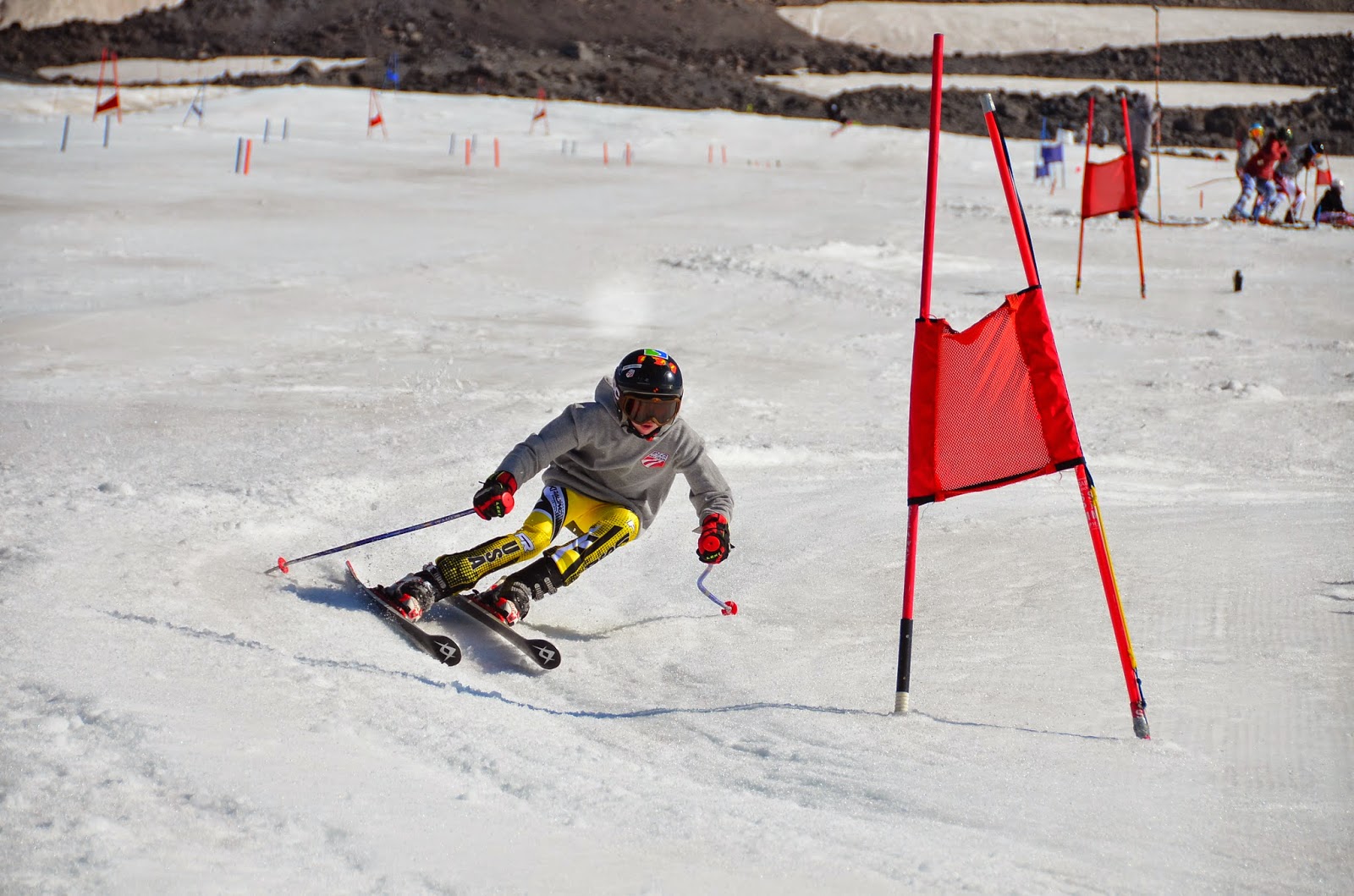
Develop 13 year olds with World Cup skiing!

All the elements of World Cup skiing technique are in this 13 year old skiers turn. This technique has been developed through movement training over the past 6 years.
What specifically are we looking for? First this is achieved with the understanding by the skier, of 5 key principles and they are achieved through constant reminding, questioning and self-evaluation and precise use of exercises.

Key ingredients or Essentials:

!. You see a strong upper body to lower body relationship that increases rather than decreases through the arc. This ability is rarely seen in 13 year olds, especially on steeps like this, on hard chattered ruts in GS. This is coached and learned, based on a partnership between athlete and coach that requires time and effort, doesn't happen naturally or by happenstance.

2. The inside ski is light and all the energy from the arc is going through the leg to the outside ski, "skeletally aligned". Some canting of the boot facilitated this, but the skier's dedication to skiing movements and the correct exercises refined it.

3. The inside ski is pulled back and the skier is perfectly balanced Fore/aft. An unusual capability in this age group, again it's a coached and learned; the emphasis on this movement is what attains it.

4. Although the one key element that is not easily seen in a one photo frame, is also present or this skier could never reach this performance. And that is "tipping ability". This skier reaches quality turns like this through tipping movements by increasing his ski angles through the arc; beginning at the initiation and he keeps increasing these angles until the release. There is never a stagnant or parked moment in this skiing. This refers to "lateral" movements in the boots, which is aggressively followed by inside leg flexing, tipping and relaxation.

This is one example of what is happening in other groups we coach and we are very proud of the kids, their dedication, the effort and hard work shows.

Thursday, September 4, 2014

Zack at 7 years old and 10, using PMTS coaching.

Imagine your 7 year old skiing like this. 


And at 10 years old evolving to this level!


Monday, September 1, 2014

"PMTS Racer Development Programs". Results speak for themselves and pictures even speak louder.

"PMTS Racer Development"  these kids know exactly what they need to do. We develop their understanding and movement abilities. They know how to make the right movements, where to make the movements and how to create the angles to become skiers with World Cup Movements.


These racers are coached with the same movements, but they have their own way of expressing this movements.
The angles created by these skiers are through relaxing movements, not pushing and forceful ones.

It is important to know how to transition, to get to this level of preparation for the arc.


These boys and girls ski very fast, on any son woe course, this is steep and very hard snow.


Again these racers learned PMTS skiing movements, Each has their own personal way of demonstrating good skiing movements, but their foundation is the same.
Here we see Check Point 1, already built in this racers natural instincts.
Again "Check Point 1" perfectly demonstrated, skiing the outside ski, just before transition.


Above, Zach is 10 years old. All the rest are 13 years old.

Wednesday, August 20, 2014

USSA Skills Quest Programs, are inadequate for alpine athlete education and preparation.

The short story is that Tiger Shaw has the new position CEO of US Skiing and USSA, and can address the inadequacies in USSA and US Ski Team Development immediately, not next year. Nothing has been done yet, but we are waiting to see how this happens.

Every year, month, week you wait and leave this program in place, will take years to repair the damage. If you are a parent or a program director you should be very concerned.

Reviewing USSA Skills Quest leaves me walking away so unimpressed, it's the reason for this Blog topic. The key, most important areas of skiing are not mentioned or addressed and no movements that accomplish the high level skiing movements are recognized, presented, discussed or demonstrated in Skills Quest or by USSA Coaches Education.

Key missing ingredients of modern skiing that USSA does not recognize in their programs are: teaching or coaching of inside foot and ski use, transitions or edge changes, tipping skis into angles, creating and coordinating upper and lower body movements. Compare Skill Quests to the PMTS Check Points, 3 are posted on this Blog!!

The USSA programs use ineffective PSIA, (ski instructor origin) movements that don't apply in 40 mph ski race speeds. PSIA teaching and movements aren't designed to use Balance, and it doesn't present how to achieve it, how to modify it, regain it and how to create it. These are areas that are not delivered or addressed in "Skills Quest" either for the levels needed to be a world class racer. These are the most import aspects of skiing and developing skiers to the highest levels.

"The USSA Skills Quest program is so out of date and old fashioned, it's regressive."

We coaches in the US were using rejected some of the "Skills Quest" approaches 30 and 40 years ago! It's time to move to the modern era. Basic fundamentals are important agreed, but the ones in Skills Quest are not the ones you want to develop. And the single one that is reasonable,  Skiing on the outside ski", can easily be completed by 7 year olds. However the other tasks in Skills Quest shouldn't be done by 7 year olds, because they will hold a developing skier back..

There are many programs in the US that are far beyond the understanding of skiing that USSA is presenting. My advice to parents is keep your kids in good home programs (like Burke, Rowmark, Snowbird, & Waterville Valley) not self-interest programs promoted by USSA.


Sunday, August 17, 2014

US Ski Coaching in trouble!!!!

The kids in our camps are making amazing progress. They are learning "movements" that world cup skiers make and use. (Stay tuned I have photo coming after camp.)  I watch other camps and groups at Mt Hood and many are working on wedge turns, wedge hopping and pivot slips, these are totally incorrect movements for development of proper skills, and not for development athletes or expert skier development. Or anyone really? These are maneuvers that are biomechanically opposite to the movements racers need. The strange thing is that I rarely see expert movements being coached or taught to kids in camps. There are a few very few lights in the dark tunnel and they come from some of the established programs like Burke Academy. Well each to his own I guess, but if I was a parent and my kids were being made to do hop wedge edge sets, at a race camp, I'd be very upset?

And this is coming down from the US Ski Team and coaches education these people are at a loss and kids are learning skiing that will hold them back.

Fortunately many of the bigger programs and academies (like Burke) are not adhering to the US Ski Team's ski school instruction based development philosophy, and approaches in recent years. There is a division in philosophies between the well established programs and the US Ski Team, as there should be. The US Ski Team is on the wrong course.

Tuesday, July 8, 2014

Why is Coaches Education under the USSA umbrella so difficult to establish.

What happened at a coaches educational meeting during the winter of 1980 in New Hampshire? Georg Capaul, at that time,  Head Coach at Waterville Valley and I, at the time, I was program Director at MWV Ski Ed. Fd. George and I saw a need to work together not apart as program competitors, to get coaching more constant for New Hampshire race programs. We invited coaches from around the State to attend and we introduced a series of basic ski racer needs. We came up with some fundamental skiing requirements for developing racers. The coaches that attended put together a skiing movement program for racer development and we presented it to the clubs.

Comments by Crawford Pierce: Ex-US Ski Team Coach, Burke Mt Coach and Rocky/Central Development Region coach about that event.
"They were the most innovative and instructional coaching clinics I have ever attended."

A few years later USSA formed a US Coaches Association. With it, coaches education began at a national level. Unfortunately, coaches education at the National Level didn't get much traction, although there were accreditation levels established with certain criteria. This languished for a few decades; and two or three coaches education directors were hired by USSA, but no real viable coaching approach or system developed that US Development coaching could use. Definitely nothing that "US Coaches Education" did  lasted and carried over into anything worthwhile for today's coaching needs. Most of the well established race programs and academies gave the National Coaches Education programs lip service and continued to do what they thought was the best way to develop their racers.

Now to the present day. There are numerous coaches education titles such national educational director, or development director, being throw around at Park City the center for all US racing. However none of these positions, individuals or committees have come up with a viable US coaches system. Sure they have the "Skills Quest", actually this is in my opinion, a horrid system of contrived skiing maneuvers that has very little to do with teaching basic racing and skiing abilities needed for kids. And now it's part of the selection process, a disaster. The more we go forward, further we go back.

However, they did choose the correct name " Skills Quest"?? Shouldn't USSA know how to develop skills and tell coaches around the country how to develop these skills, not be on a "Quest" for Skills??? The irony in the name tells the story.

Now USSA had really done it, thrown in the towel and admitted defeat: they are using and going to PSIA for their ideas about the coaching of basic skills. This is a huge slap in the face to any coach who has been working in the USSA system for the last 20 to 30 years.

USSA is telling the US coaches that they have failed and they are saying with this, that USSA  has failed, as well, with the Coaches Educational programs over the last 5 to 30 years.

Now the present brain trust rather than coming up with a universal movement based teaching system for racers, from reputable national level race coaches, they have relinquished this responsibility to PSIA, the ski instructors of America.

 I have been with PSIA, for 4 years I was on the National Demonstration Team. I was also a trainer and an examiner in PSIA for 4 years. I left it because it had nothing to offer me and it is stagnated. My background before joining PSIA was with USSA and development coaching, in three major race programs.  I also was Head Coach of two US Ski Team development programs, one for Harald Scheonhaar and one for Bob Harkins.

When I make the comparisons between what the reputable coaches in the country know about ski racing and coaching compared to PSIA's trainers and technical base, it's amazing to me that anyone would encourage the use of PSIA for ski racing technique. PSIA technique and racer needs and development are incompatible and have technically opposite needs and outcomes.

Why has the brain trust at USSA reached out to using a ski teaching program that has not shown success with the general skiing public, let alone with elite or development athletes?

Few of the general skiing public take PSIA lessons, beyond beginner levels. There are so few middle and upper level lessons given in PSIA because skiers don't see advancement. In my opinion this is because skiers at middle to higher levels don't get instruction that helps then become better skiers. Yet USSA is applying PSIA training methods to ski racer development at the national level.

The general public in general doesn't take PSIA teaching, especially at the middle to upper levels for their development.  If  recreational skiers see limited progress or have little desire to take lessons to become better from  PSIA, I shouldn't have to enlighten anyone about what this means for the nations junior racers.

How desperate is USSA Education that this is their answer for teaching and coaching ideas? Anyone from mature, major race programs,  I mean Ski Academy coaches, in the East and West, can develop a coaching program that meets the needs of 90% of racers. There are programs in the East and West that are doing an outstanding job, for example: Burke back east and out West, Steve Bounous's program at Snowbird. And why can't USSA develop a task force of established coaches, who have a wealth of experience, and can be called upon to create a development coaching program?

USSA is glad and immediately ready to take credit for the Shiffrins and Goldbergs, even if they had nothing to do with their development. We are in a cycle where we have to wait for the next "child phenom" to show up. We don't produce top skiers in this country from the development pipeline .

Let me have a guess at why a development pipeline doesn't exist and why it is not happening?  Are the wrong people in charge of USSA Coaching and Development? Are they totally out of touch with racer development? Do they have a racing background?  Can they communicate with the development programs. Do they understand or know US ski racing and how it's structured? In my opinion, they don't understand the needs of racing at the highest levels. It could be any one of these and probably a combination of them.


This is just the tip of the systemic failure of USSA development, that needs immediate addressing. The racer numbers are down, the athletes are paying enormous amounts of money to train and prepare for a shot at the US Ski Team. The development pipeline is weak, empty or even non-existent.

Tiger Shaw has some serious issues to address in his new position, he will either go with the status quo or he will shake things up. If the second of these two options is not chosen,  USSA is in line, in my humble opinion, for the biggest drought in it's racing history.


Thursday, June 19, 2014

US Ski Team is not the answer to domestic coaching and development.

Whenever there seems to be a drought or a crisis looming in US ski racing everyone starts to point fingers. Tiger Shaw basically said, " There is not much talent in the pipeline."

Sasha Rearick, Head US team coach,  "“We’ve fallen off the mark in the technical disciplines, slalom and GS, without a doubt."
US Ski Team coaches have finally realized what I've been saying for the last 15 years. However, do they have the "technical coaching skills", to raise the level properly or quickly?It's too late for the 16 years olds, you have to start with the 8 year olds or 10 year olds, in their home programs. This isn't anything the US Ski Team can solve, it needs to be done at the entry levels. By the time it gets to the US Ski Team level, it's too late.

More details in this Ski Racing article,  however this is a public relations article it has little content or offers no real solutions.


I'll make these statements not because I want to damage USSA coaching, but the reality is this. I've observed domestic racing for 35 years. The US national coaches association is where the trouble is, it's not the kids.. And USSA should not try to blame the US domestic coaches. USSA has the power to dictate what and how skiing is coached in this country, but it has failed. Now even a branch of USSA, the Ski Team, recognizes this.

It's easy to identify the problems,  they are obvious, at least to me. These problems go right to the top racers in the US, look at Ligety's slalom? Technically it's terrible and he's been working on it for the last three years, without change, that's a coaching issue. This has been documented in detail on this Blog. 

It's another thing to know what to do about your overall skiing problems. Where is the solution? USSA needs to totally revamp the coaches association and start to educate coaches, starting with biomechanics and movement fundamentals. But it's not getting done, because human nature is, not built to look internally. 
And the changes needed,  will never happen with PSIA as the driving force for, US coaching and athlete development, that should depend on elite world class skiing knowledge. PSIA isn't designed to for this, they don't develop athletes,  and doesn't have the credentials to coach elite racers or train US coaches. That's like asking your lawn mower mechanic to build you a Ferrari racing engine. PSIA is a ski instructor organization, it's strength is to give tune-ups to recreational skiers.

Do US ski team coaches have the skills, time and influence to make it happen? Can they make happen what they have identified as problems in US development? 

Is a one time spring ski camp the beginning of a national development resurgence? Even if the coaches did have the perfect program at this camp, is it a development solution or a PR attempt. The problems for US skiing go much deeper and require much more attention.  This has been substantiated (not that I needed this confirmation) to me by numerous coaches who attended the national forums at Park City this spring.
US skiing is in world of hurt, there is at the moment very little going on in the pipeline behind the present team, sorry.
This may sound negative, but it's not, you have to identify the problems to be able to fix them. I'm not against US Skiing, but I am very critical of the way it's been managed.

Tiger Shaw has his hands full, and not just with this issue. It's not going to be solved with a few camps and a Press release, it will take a mini revolution within the US Coaching and Education. 

Wednesday, May 7, 2014

Harb Ski Systems Summer Race Camps, Mt Hood.

                     Another great skiing experience coming in August

                                   Harb Ski Systems

This isn't just another Ski Race Camp, it's not just silly drills to keep kids busy. This is an education about skiing and skiing the way the best skiers ski. It's focus is on learning movements, not words and silly maneuvers. This is a ski education that will last and that you can use when you need it to ski fast, but in control. This camp has no fancy World Cup  names or celebrities, just honest to goodness ski education and improvement.


Here is the information  about our junior race camp at Mt. Hood, in August. Please contact us with any questions you have after reading this.


 philosophy:
Our camp is private, and not offered to the public. It is offered by special request and for invited athletes. We are not one of the mass-production camps that stays at Mt Hood for the whole summer. We are interested in working with highly-motivated athletes who want the best coaching and educational experience. Our involvement with attending athletes is usually long-term: once they experience PMTS race training, they want to continue with that program and level of coaching. We provide a technical skiing base and technical understanding of skiing that the athletes will carry with them as they evolve as skiers and racers. This is not just a week's ski camp experience; it's an education for their lives in skiing.

Parental/coach involvement:
We ask that a parent, guardian, or a current coach be involved in the camp, including:
  • providing lodging & meals
  • supervision during the non-ski hours
  • transportation to and from Timberline Lodge each day

You can stay at Timberline Lodge, which has dining options. This simplifies access to the lodge and slopes each day – no driving needed!

The town of Government Camp offers many different options for lodging, from renting private homes, to condominiums (Collins Lake), to hotels & restaurants, to hotels with meal plans (Huckleberry's)...

You can find private homes & rentals on vrbo.com

A google search for “government camp or lodging” shows many results...

Here is the web page for Huckleberry's, if you prefer not to cook...

Dates:
August 4-10, 2014
The camp offers 6 days on snow. The starting plan is 3 days on / rest day / 3 days on. We will adjust this schedule if needed for weather.

Cost:
Please contact us.

Coaching groups:
We plan to have 4-5 racers per coach (maximum 6). Coaches are Harald Harb & Diana Rogers. We will have one or two assistants to help with set up.

Skis & equipment to bring:
Athletes should bring slalom and giant slalom skis (ok to bring GS only). We will be running GS gates. We will not be running SL gates, so you do not need full armor.

Ski & training plan:
The first three days of camp are technical free skiing. Day 1 is on SL skis; days 2 & 3 on GS skis. Days 4-6 are GS gate training. We may modify the schedule if weather or conditions dictate.

Daily plan:
The coaching is from lift opening (scheduled 7 AM) to approximately 12 PM, with a snack/rest break on-hill. Video and technical review will be held each afternoon, for approximately 2 hours total, at a location to be determined. No other physical activities or dryland are scheduled. The athletes should be working on physical preparation before and after the camp week, but we want full energy from them on-snow during camp. There are plenty of fun, light activities in Government Camp after the video/tech sessions.

Attending athletes:
So far we have 5 athletes confirmed from West Virginia. We tentatively have 3-4 coming from Alaska and the Midwest.

Deposit and payment:
Since enrollment in this camp is very limited, please send us a deposit as soon as you enroll. We accept payment by check/money order; Paypal; and Visa, Mastercard, or Amex credit cards.

Gate training


Sincerely,

Harald and Diana

Friday, May 2, 2014

Spring days mean mountain roads and lots of twists.

First day with the 911 on an extended mountain trip.


Tuesday, April 29, 2014

For 65 year old athletes, precision in your training, creates success.

It's hard for me to even speak that title out load, let alone write it. Yes, I am a 65 year old athlete, hard to admit. Sometimes saying it makes it more real, wake up it's reality. We are in a different world then when I was growing up. 65 year old men sat on the couch, watched TV,  drank beer, (martinis) and played bridge.

Now 65 year olds are training for sports, staying fit and flexible.

In the active part of my life, every season brings on a monumental change in physical conditioning required to change sports. Much has to do with the sport you choose and the conditioning needs of that sport.


Changing from skiing to road cycling for the summer isn't too bad or that difficult a transition.


A change over however from skiing to rock climbing is long and painful; and the same goes for the reversal back to skiing in the fall.


It always starts out as a daunting process, but when you get into it and get on the rock, motivation for climbing at higher levels and or for the same levels you finished the previous season with, comes on strong. 

The annual quest for the same upper body power, grip strength and endurance I remember having, has already begun. Out on the rock I know the first attempts will be dismal, we always compare ourselves to the levels of performance we had or want. 


This is challenging not only from a physical stand point, but also mentally. It's not dissimilar from what many athletes confront when recovering from injury or stepping up to a higher level of competition. The mental game, the physical challenges and technique all require higher levels of   development for an athlete to be competitive again.

And pacing yourself in your training is surely one of the most frustrating parts of this process. As we age the body reacts differently and has different needs. Rest and sleep are high on the list, without them hard workouts wear you down,  rather than build you up. The formula for precisely moving and varying the type of training and workouts you do has to be much more strategic than when you were 25 or even 45 years old.

You can no longer pound out 7 days of weight training and aerobic training in one week, you have to mix up your rest, intensity and type of activity. The goal is to keep improving without a major set back, like overtraining, getting sick or causing an injury. Fatigue or overtraining is likely in the first few weeks of the transition because you are motivated and in a hurry.

This is where a training journal and a written plan can be huge in developing success. Also keep your training log from year to year and consult with it, keep track of your previous year's success and failures. You can learn so much from your own experience, and that's the best way to refine your program from year to year.

I know where I was last October preparing for skiing and I know where I was last June, getting ready for my climbing season. I'll tweak my workouts to increase the fun and enjoyment of the training activity and also the effectiveness of it. Time is of the essence, the climbing season is short and I know I have to be ready for a long ski season again by October. Precision is my overall goal, training smart, means planning. Planning perfectly, may take a year or two to establish, but it's worth the effort,  it's scientific and personally satisfying.

Sunday, March 23, 2014

PMTS Direct Parallel Skiing, "The Two Ways to Ski".

You can learn to ski with your skis in the snow surface or ski by barely scratching the surface?


Things to look for in this video of PMTS Skiing? Into this video, the first 5 seconds will demonstrate the difference between "The Two Ways to Ski".  Notice the group of skiers flying by, (noisy skis) they are barely scratching the surface of the snow, granted it's hard snow some places even ice. Then compare that skiing, to the skiing in the rest of the video. 99% of skiers on the slopes ski like the group that flies by.

This is fine on a groomed slopes with no obstacles, bumps or deep snow, however at any big mountain this skiing will not hold up. Yes, the skiing of the two in the red suits will hold up everywhere, in powder, bumps and be enjoyable on any snow.

Saturday, March 22, 2014

"Two Ways to Ski" "PMTS Direct Parallel" Skiing Demonstrations,

                                          "Two Ways to Ski"

                (Video of this skiing is available on the Blog.)

There are two ways to ski, two ways to learn to ski. If you start on the correct path from the beginning everything will be much easier and more enjoyable as you head toward advanced intermediate levels. Most skiers never experience the true joy of the sport because they are compromised by the way they were introduced to the movements of skiing.

Below in these photos is one of the "Two Ways to Learn Skiing". This of course is the end result, but the process is just as rewarding as the end result.

Take note of the sometimes less obvious performance highlights of this "PMTS Direct Parallel" way to learn skiing.

This is a steep slope rated "Black Diamond Run" every photo is from a different run and set of turns, yet there is amazing consistency of performance in every set of photos. Take particular note of the lack of extra movements, the angles of the skis and the body. This is sustainable in all conditions and all slopes no matter what snow or surface, when skiing with this method. This is not "Old Fashion Ski Instruction". This is PMTS skiing, derived directly from World Cup skiing techniques.


               The Slope is on one of the Steepest in the Mid-West, at Welch Village.
                                                            Dual Carving with Diana Rogers


                               Above is a simultaneous release, knees flexed, and in transition.
       This is on the Welch Village Upper Snow Field. Who says the Mid West doesn't have Glaciers?