Monday, January 20, 2014

Check point 11, Inside Ski Management

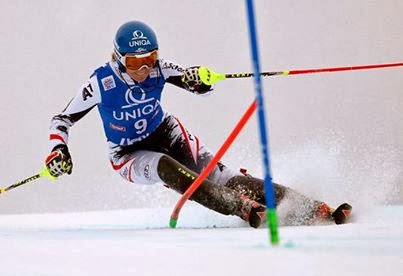
Inside ski and foot management needs to be trained and taught. It is rarely developed completely without guidance and coaching on it's own. Two of the Masters on the World cup of inside ski and foot management as seen here.

Above is Felix, how can you tell he has inside foot management, because he has pulled the inside foot back, the ski tip is still on the snow, but the tail is lifted. When you practice inside foot management this is exactly what occurs.

Marcel below, notice how bent his inside knee is yet his boot is back as far as the other knee, which is touching the boot. These two examples are not happen-stance and not what every World cup skier is born with. This is trained and it it is part of proper expert skiing.


Examples below of two skiers, in slalom, who used to be on or close to slalom podiums. They have failed to keep up with the changing techniques of modern slalom. Very poor inside foot management and also inside foot breakdown is obvious in this skiing, example in photos .

When inside foot  management is lost it also affects upper body balance, often counter balance and leaning are results of the lack of inside foot attention during training.

Saturday, January 18, 2014

When you see racers missing this movement, they are losing huge amounts of time.

A short while ago I received an e-mail from a racer. He was asking about transfer to the LTE. He said a coach told him that it isn't something you should use.  Well, I do advise you learn what it is and how to use it.

Once you release the big toe edge of the stance ski your weight and balance need to go somewhere and this is where it should go.

Both Felix NEUREUTHER (here) and Marcel Hirscher use this extensively, those who end the turn with too wide a stance have great difficulty making this movement.

Tuesday, January 14, 2014

For Schiffrin what a difference 3 weeks can make. A win at Flachau.

Shiffrin wins slalom at Flachau, 1st run by 9/10 of a second. 
This is a big change from 3 weeks ago for her release and transition. Notice the feet are aligned and weight is off the stance foot, transferring to the uphill, little toe edge ski.
                        We see this in Hirscher's skiing example below. He is even stronger and more consistent with the move, with a narrower stance. In this frame it is a fraction of a second before he totally unweights the stance ski and transfers to the little toe edge of the uphill ski.
 Three weeks ago the release looked like this, stepping to the big toe edge, this is her weaker alignment side. But it has been more controlled  in the last two races. There are still some signs that it's not all gone yet in some turns, but this is a major improvement, also shown by how much she won the run. This transition costs time, it's a big toe edge, to big toe edge transition. This means the ski is grinding in the upper part of the arc. Whenever you see this step out type transition, it's an indication of time and speed going away.
Here is hirscher transferring to the little toe edge of the up hill ski, for his release to transition. This is the key move in slalom skiing. This is the move that Ted Ligety can't seem to develop.
Notice the difference between this and stepping to the uphill big toe edge. 

Sunday, January 5, 2014

Comparison, Richie Berger.

Harald Harb
                                                                   Richie Berger
                                                       Ski like an Austrian
Richie Berger (above in Blue)  is one of the best freeskiers in the world and represented Austrian for many years in demonstration skiing.

Monday, December 30, 2013

Comparison between Shiffrin and Schild in the same turn.

Schild is already arcing, hips and body lined up with edge.
                                    Shiffrin's weight is on her inside ski, wide stance.


                                             Same Turn above the gate, in transition.
             Schild narrow stance, already released old turn and ski, standing on uphill, little toe edge ski. She is still holding her CA from the previous arc. She has already transferred her balance to the new ski, for the next turn.


Siffrin in the same turn, almost exactly the same place, wide feet,  pushed her new outside ski away to exit the turn. Caught in wide stance with balance between skis.


Sunday, December 29, 2013

How does Maries Schild do it? The best slalom skier to have ever lived.

It's easy to say, as they do on Universal Sports telecasts, "she brings it", she has the "energy", she  makes "no mistakes". But there is so much more to it. Those are skiing  clichés  but don't describe how she does it. For a more in-depth look at almost perfect slalom technique of Maries Schild read below:
Upper Body compliments her feet.
Schild's upper body Counter-acting is stronger and her Counter-balance, not only better, but earlier in the arc, than the rest. She has mastered and uses all of the "Essentials of Skiing", in every turn. Most of the field only has some of the Essentials, and rarely use all the Essentials in the same turn.
.

In the last 30 turns, in the 2nd run, Schild beat the field that ran before her by 1 second to the bottom. She has yet to ski "all out" in two runs. If she does get back to being able to do it, she will begin winning slaloms by more than 1.5 seconds. This is how dominant she was before her injury. She also beat Shiffrin by 1.1 seconds in that run to take the win. 


Lower Body sets it up: Schild has emphatic outside ski retraction and flexing at the release of every turn, in other words, she pulls her leg into a strong flexing action when she releases the ski, and transfers to the other ski, while it is still on the little toe edge and is still that inside ski.

This is so obvious, but few coaches know how she achieves it. This is worth 1/50 of a second on every turn. Schild also has the narrowest stance and holds the inside ski and boot close even in the turn, this allows her to manage her inside ski tipping and pull back. She keeps the inside ski lighter for longer in a turn, than any of the others. The others except for her sister Bernadette, and Zettel, all use the inside ski to lean into. Even Shiffrin, her stance falls away (feet get too wide horizontally) and she ends up on the inside at the falline, this takes much of her rebound energy and edge hold away, out of the release.

Tuesday, December 24, 2013

Ted Ligety and Marcel Hirscher

Introduction
Since the beginning of it's development, in 1997, my teaching system PMTS, based on world cup racing, and described in my first book, "Anyone can be an Expert Skier", has focused on new techniques. I'm referring to new techniques that have evolved and are used by world cup skiers for the past 17 years or more, but are rarely realized. Every book and video I have produced 8 in total, has developed the focus of inside ski tipping and inside knee flexing. This PMTS movement series with use of the inside of the body, begins at the release of a turn and continues all the way to the end. The Austrians have developed this further in their racers than most other nations.  


Hirscher has more emphasis on inside leg flexing and tipping. He really holds his inside foot back. He holds it longer and stronger than the rest. The angle toward downhill, of the inside leg is incredible. You can only achieve this if your focus for the releasing movements are on tipping of your new inside ski,  foot, and bending of the inside leg. In other words, get it out of the way. 
 Ted is more old school, Big toe edge dominant in this engagement.
Two of the best three GS skiers show differences in movements for turn engagement.

Many will say this is no big deal, as with the slip I mentioned in the previous article, no big deal either,  however, 1/000 of a second is 2 tenths, in a 2 minute, 30seconds two run GS. Add a slip at the bottom of the arc from squaring up, at the release, and you have 4 tenths in a hurry.

Direct comparison, Hirscher to Ligety

Because Ligety and Hirscher have different body types, there will be slight differences in the way they need to release, engage and transition between turns. These are the three areas of ski turns to focus on when comparing skiers. What movements do they use to release, to transition and to engage the skis? Their  upper body to the lower body alignment relationships in these critical parts of  turns however, should stay similar.
It goes without saying that you have to know if this is an anomaly or are these movements more than 40% repeated in a race run. These two comparisons here are consistent with most turns for each skier.
 This is just prior to release or the finish of the arc, note the differences in upper body. Ted is squared up, Hirscher is still counter acted. Ted lost his outside ski.
This is the same turn, same spot, Hirscher knocked his gate down, the camera zoom are slightly different, otherwise it's the same spot on the course.

Monday, December 23, 2013

Hirscher uses techniques usually seen by Ligety, He out Ligetyed Mr GS.

A few differences that look minor to many, but added up over a whole race it's 4 tenths of a second.
First thing, in this course, Hirscher's line was tighter, closer to the gates. His arcs were round,
but shorter, shorter than both Ligety and Pinterault.

(above Photo) Hirscher Carving above the gate, what Ted is known for in his best GS races.


Hirscher has this amazing ability and part of technique which neither Pinterault or Ligety use to the same extent, and that is his upper body control and discipline. Hirscher holds his countered relationship to the skis longer after the gate, he actually increases it. This reduces his movements  needed in transition, therefore he can relax and have more time to set up the new arc.


Here you see Pinterault dropping that inside arm behind his hips, his upper body is therefore square to the skis, and he is still pushing off his lower ski, and the upper ski is already flat. In contrast, Hirscher rarely steps over to a new flat outside ski. Hirscher rides the "Little Toe Edge", while it's still at a high edge angle out of the arc. He stays "Counteracted" with his torso to the skis. This rotation doesn't happen in every turn for Pinterault, but it is an often enough occurrence in key turns to have an effect, for the edge engagement for the next turn.

Sunday, December 22, 2013

Hirscher above the rest at Alta Badia, Why?

After I posted comments on Facebook about the World Cup Giant Slalom at Alta Badia,  it becomes really obvious after reading the responses,  that many viewers have difficulty looking at and seeing what  world cup skiers are really doing. So in an attempt to educate viewers I'm posting World Cup Skiing analysis here.
 Here Hirscher is in the very difficult part of the course where many others made mistakes. He also had a great save here, but he started the turn perfectly.

Look at the key reference points in his skiing that makes him the best skier in the world.
1. Upper body counter acting
2. Inside shoulder forward
3. Inside foot and ski tipped, to the same angle as the outside foot and ski.
4. Upper body is Counter balanced and turned away from the gate.
5. Inside foot it pulled back under his hips and outside knee is touching the inside boot.


Only a few skiers manage this kind of skiing, this is the exception, not the norm. The below photo from  Alta Badia shows the same characteristics.

When analyzing skiing you have to look at what the best skiers are doing differently than the rest and how they are evolving skiing beyond the normal; if you want to stay ahead of the game. Most coaches don't see the next level and don't look deep enough into the biomechanics.

Sunday, December 8, 2013

Bode Miller using classic PMTS style counter balance.

Bode no longer so wild, more Classic!!!

Bode is on fire, with his upper body and inside arm up, forward and high, this is classic PMTS technique we teach.

He is also is flexing and tipping the inside ski and leg to get angles and keep the ski light. This action of the inside leg moves all his weight (Cg) and balance to the outside ski .

Skiing at this level, is no longer about pushing and driving the outside knee and ski; it's about moving the pressure to the outside ski by creating the angles with the inside leg and inside of the body. Totally opposite of what is being coached.

Friday, December 6, 2013

Mikaela Shiffrin has picked up her game from last season. Impressive for someone going from 18 to 19 years old.

The two big factors that Hirscher and Shiff have over the field is inside foot management. Most racers at any level, don't pay attention to this crucial inside foot, boot and leg dynamic. Notice on all the photos on my Blog;  there is one thing represented, and only the best 2 or 3 skiers in the world demonstrate it.

Which is, inside foot and the inside leg leading the movements into and in a turn. Notice that the top skiers don't have to reach to make contact with the snow with the inside hand. They get their angles by performing differently. They create the angles needed with the whole body with inside leg flexing and inside boot tipping. If you dig deeper into this Blog you will see this occurring over and over. 

Shiff has improved in these areas. She keeps the inside foot back and under the outside knee by pulling back on that boot. She tips and bends the inside leg out of the way to allow her body to drop to the inside. This creates huge ski and body angles. Therefore: her upper body doesn't need to lean or rotate. That's another special set of movements she has learned and improved on. She is therefore stronger skeletally, which is bad news for her rivals. 

In slalom this has also improved, so she's even a better slalom skier than last season. She could win the overall this year. Riech is strong in all events like Tina Mase was last year, but she isn't going to win enough points in GS and slalom. If Shiffrin does what she shows now, and continues to build on it,  she will win GS and Slalom races, like Hirscher, to win the overall without speed events.

Saturday, November 23, 2013

Does anyone still want to argue for skiing square to the skis????

Marcel Hirscher in GS, like all the top racers he uses Counter Acting with his hips and torso, to stabilize the upper body and keep from creating any rotation. Rotation squares up the torso and loses the back of the ski. Rotation also makes a skier use upper body movements to start the next turn, this is much slower and throws you out of balance.
For recreational skiers, add more counteracting to your skiing and hold a better edge. Few skiers can ski with a square hip, it's a much weaker "position". Counter acting requires a movement to achieve it. Square is a position. PMTS skiing relies on teaching movements not positions.

Thursday, October 31, 2013

Alexi Pintauralt, Best Skiers Inside foot Check Point

Everything I've written about ski technique, beginning with the, "Anyone can be an Expert Skier 1" book, is in this photo of modern world cup technique. Let's review:

1. Inside foot pulled back, and ski is lifted or light.
2. Starting with the leading arm the upper body and torso held in counter acted relationship.
3. Outside knee to inside boot proximity.

It's simple to point out these key reference points for skiing the right movements. However learning to get here, requires the right movements. That is where PMTS really shines, it tells you and explains exactly how to get to this type of skiing.

If you had been following PMTS 10 years ago and using PMTS movements, you would  have been 10 years ahead of what is happening now.

Monday, October 28, 2013

In the last throes of fall training. On the "Deflator-Mouse"!

This is the move to the dihedral exit to the chains.

It's still the bat route; therefore the name, based on the Austrian word for bat. You can look it up on "Mountain Projects", search "Dumont region" under, "Deflator-Mouse".

Great weekend for climbing, finished up and red pointed my fall projects. Also working on two 5-12+ climbs Richard Wright has put up in the same area.
Above, top of climb on the upper crux.
You have to get into that crack in the dihedral up from my right hand. Getting over the bulge involves stemming your foot way out to the left wall. — 


Richard has done so much work these last two summers, putting up about 15+ climbs. Great to have him coming up our way.


                            Above, making the move onto the bulge, this is the hardest part.
You take one step up and you are hanging from your fingertips, the left foot has to go to the dark crack on the left wall and the right foot up to the knee, The next left hand hold is under the black triangle, it a dead point move, you make and you're good. You miss it and you're "off the wall". — at Mill Creek Cr


This is a week earlier drilling holes in the rock for bolts and hangers.

Wednesday, September 25, 2013

Austrians ski PMTS technique

Often coaches forget to compare the similairities because the key elements of skiing are hidden. In our PMTS techniques we have identified these key elements as the "Essentials of Skiing". Let's look at the similarities of these two skiers. Here I'll point out the Essentials that are similar for  world class skiers that are not seen in struggling skiers.


Here Anna Fenninger, a World Champion demonstrates perfect technique and balance. Here are the key points that turn out to be similar in both these skiers.
1. Inside leg and ski tipped equally to outside ski and leg.
2.  Inside knee bent and outside leg is straighter.
3. Upper body is counter balanced to lower body
4. Upper body facing toward outside of the turn, inside arm, hand and shoulder leading.
5. Even at these angles, shoulders are level.


Here Harald Harb demonstrates similar technique, possiblly not skiing as fast and skiing a more shaped ski, however the body and it's relationship to the turn and skis, is almost identical. Is this a coincidence or a fluke, no it's achieved by using designated learned movements.  I achieve this skiing by using the Essentials of Skiing from the PMTS approach.

Tuesday, September 24, 2013

You can learn this turn and gain control of your skiing, with PMTS!

His upper body is facing toward his downhill ski boot, his hips are doing the same. 
He quickly retracts or flexes his stance leg, keeps his upper body the same but his legs are releasing.
He is on his new edges, but light on his skis, his legs are on the downhill side of the skis, the skis have made almost no direction change, this is key.
 In every Essential of skiing there are many components of movement, in this series by Hirscher we see "Counter Acting", which is being held with his upper body and hips during the release.

We also see he is flexing his outside leg in Fig. 1, to flatten the ski, this constitutes a PMTS "Flexing Release", taught in the system and it is one of the Essentials of skiing.

In the last photo you see the tipping of the new inside ski and boot and the leg that follows. This creates the "knees apart", look and delays the on set of the new outside edge, until after the body has crossed the skis and is lined up with the forces of the turn. This is another one of the Essentials of skiing,  Inside leg "Tipping", in this case.

There are many misunderstandings in ski teaching and coaching technique. What is astounding, is that the really talented skiers get around the poor advice and let their natural instincts take over. However, even after these athletes have success with movements that are different from what the coaches suggested, many coaches justify the difference with tailored explanations that on the surface look reasonable, however with further investigate and proof, they end up completely incorrect. This is why it's so difficult to become a good skier with the instruction that is generally available. Unfortunately there are not many approaches that lead to skiing correctly that is why if you stick to the program of PMTS and learn to move with the "Essentials of Skiing, you won't have get confused.

Friday, September 20, 2013

Getting your feet behind your butt in skiing all mountain terrain.

Rarely do you see skiers committing to the "High C" transition in all mountain skiing. This movement can make a huge difference in how much energy you expend and how much control you achieve.                     
 Here is a transition well before the falline, the skis and body are engaged to the new arc. The release retraction movement from the previous turn was energetic, that is why the skis are not yet in the snow; however the body is ready for the new turn well before the falline. We call this the up-side-down position.
Here the turn is engaged and the tips headed straight down the falline already arcing a turn. This gives you an early engagement and lots of time with the skis in the carving phase of the turn, which means control and direction are easily achieved.