Friday, October 26, 2012

Comments from World Cup Skiers

SÖLDEN is the beginning of a long tough season. GS will be a different event this year. Most of the skiers in the race have grown up on shaped GS skis. Now the new rules with more loose, larger dimensions have taken the technology backward, toward the nineteen eighties, 1980. Men's GS skis are now 35m length, 195cm. The reactions have been predicable coming from older coaches, who raced and coached with the straighter technology 30 years ago.

 Here are the valid comments from racers about the new skis.

1. Set up turn higher at the top of the arc.

2. More weight or all weight on outside ski.

3. Wider line needed coming into the gate.

4. Upper body more counter balanced.

5. Less inclination, more ski angle required.

Wednesday, October 24, 2012

World Cup Skiers speak out on 35meter radius GS skis.


  World's best skiers:

It’s not secret that straighter skis will require more work, that’s why the athletes are strained and fatigued after a run. Just watch the Hirscher interview!

You have to concentrate more pressure on the sweet spot, tip to a higher angle and stand on it.

Inclination and leaning, which you might get away with on a more shaped GS ski, now can’t be as easily implemented.

Some athletes say technique will change, not really.

Technique will become cleaner and more exaggerated toward older established fundamentals, such as Counter Balancing with the upper body. This is obvious while watching the top skiers. One other big change you are seeing immediately, is a narrower stance. This because a wider stance puts more weight/pressure to the inside ski, which will cause the outside ski to run straight, because it acquires less pressure. More dominate outside ski stance will become an advantage, although it always has, these skis require setting up the top of the arc with more outside ski dominance.

 Harb Ski Systems ahead of the realization curve: At Harb Ski Systems we have been saying this for years as the recreational skis got straighter and wider. So this is how discoveries from World Cup, support and substantiate what we do in our teaching and ski selection at our ski shop.

Monday, October 22, 2012

"High Performance Skiing": Best Skiing I've seen from Ted Ligety

High Performance Skiing! Ted Ligety Training for Soelden. This is the best skiing I've seen from Ted since Beaver Creek last year. No skivoting, much earlier high "C" engagement and no out of control inclination, which killed many of his runs last year. Notice the PMTS lift and bringing in of the new free foot to set up his tipping and balance. This is pure PMTS. He did not have this last year. The retraction of the old outside ski is key to this whole turn set up. It's the little things that make the big differences. Notice how his stance narrows up, with his free foot management. Free foot management, which most coaches don't see is the key. I don't know if Ted figured this out for himself or if someone has worked with him on it. This movement makes it much easier to stay Counter Balanced in the arc, and hold CB. This video clearly demonstrates CB, Tipping, inside leg flexing. Very strong demonstration of 3 important "Essentials of Skiing".

Saturday, September 29, 2012

How to achieve the "Tipping" you see in the sketch below.

Here is a video demonstration of "Tipping" and the movements that help create what you see in the sketch below. This clip is from my, "Performance Free Skiing" DVD, available to order from Harb Ski Systems.

Friday, September 28, 2012

Skiing with the world's best technique, means "tipping", your feet, boots and skis to a greater angle, than you would normally stand with on any slope. Most skiers never realize this, and are not taught it in traditional ski school. "Tipping" is the foundation of "PMTS Direct Parallel". Study this quick sketch I put together to grasp what tipping on a slope really means. All the best skiers and experts in the world "Tip" their skis like this. Harb Ski Systems teaches "Tipping" at every camp session.
If you are missing the next step in your skiing, this could be it. "Tip More and Tip often". Angulation is a body position, tipping is an action and a movement, that either continues to increase or decrease, in a turn, but should never be static in skiing.

Tuesday, September 18, 2012

Young Italian Talent: shows "Essentials" of PMTS in her skiing.

The best 13 year old skier in the world.
Counter Balance: upper body vertical 
                                      Inside leg well bent and tipped to the Little Toe Edge

Saturday, September 8, 2012

Training for skiing!

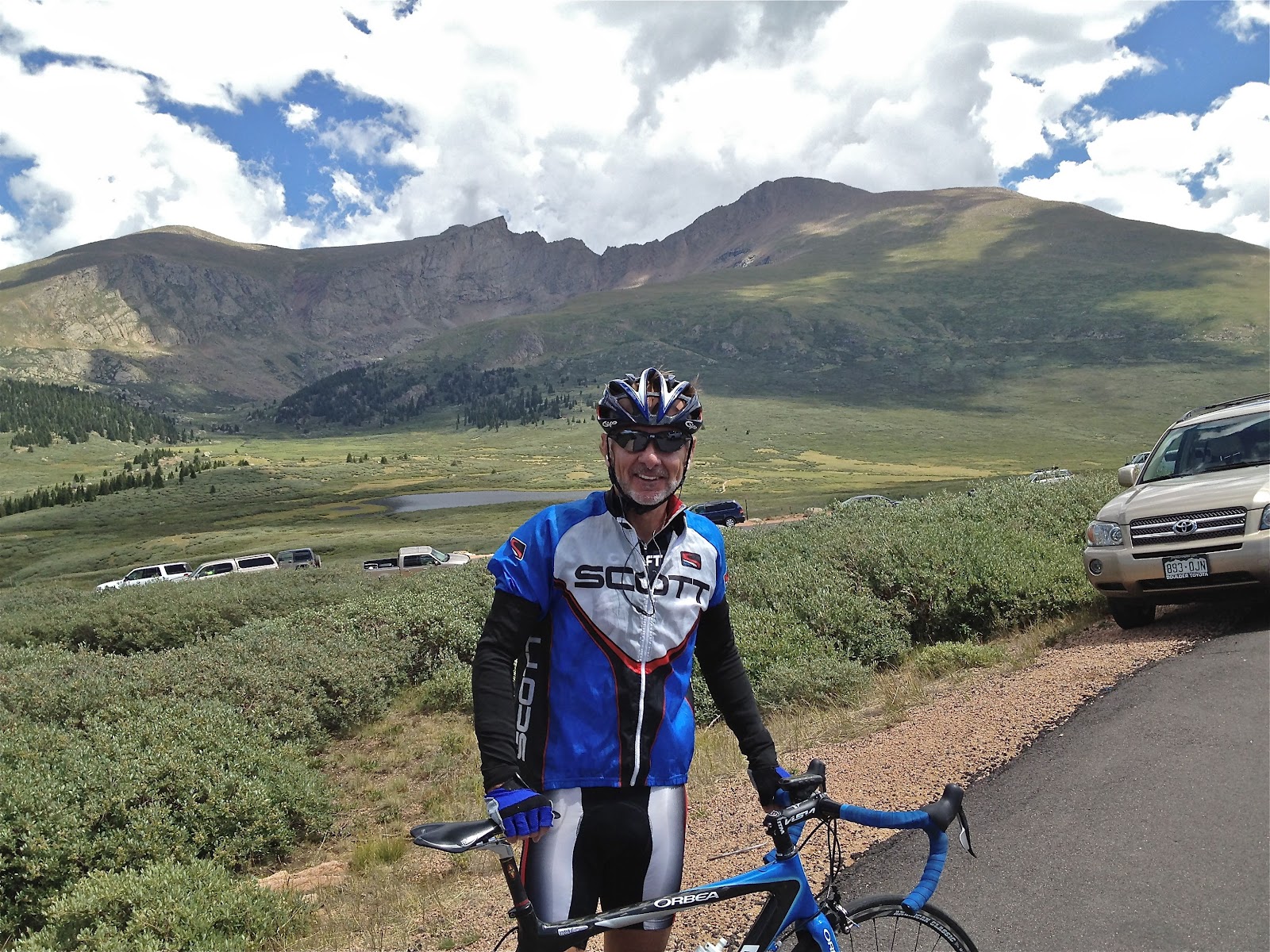
The ride 2 hours 3minutes, it was 45 degrees up there so winter is coming. From the shop, 4100ft of climbing, 22.5 miles, average speed going up 11.3 mph. Elevation at shop is approximately 8000ft.

Saturday, August 4, 2012

Putting in the miles and the time! Guanella Pass,

Guanella Pass (el. 3557 m./11,669 ft.) is a high mountain pass in the Rocky Mountains of central Colorado, US.

http://en.wikipedia.org/wiki/Guanella_Pass

                       4,700ft of climbing, in 1:20 minutes about 12 miles up, average 12mph.

Wednesday, August 1, 2012

Training, training, training, you have got to like it.

3 hours, 4100 feet of climbing, average speed 12 miles per hour, there and back. Twenty miles uphill.


Friday, June 29, 2012

What is the PMTS, "Direct Parallel Movement System?


PMTS, Direct Parallel, "The Essential Movement Based System".
Skiing involves the whole body, sometimes the whole body moves, and others times only isolated, regional, refined small joints move. Combining and co-ordinating these movements is what makes skiing fluid. We call it the “Essentials of Skiing”, using the PMTS  "Direct Parallel" system.
 The PMTS movement approach is unique in the world of skiing? 
PMTS teaches the same movements to a beginner, that are “coached” to top racers. The same movements used by the best racers in the world are PMTS movements. PMTS is not just a movement based “system”, it is the Movements of  skiing. 
PMTS movements are show-cased by the “Essentials of Skiing,  PMTS brings to the table a straight forward simple agenda of 5 “Essentials”. 
The 5 PMTS Essentials are, 1-Tipping, 2-Flexing and lengthening, 3-Counter-acting, 4-Counter-balancing, and 5-Fore-aft balance.
PMTS is straight forward, because it doesn't discard, reverse or eliminate any “Essentials” along the path to becoming an expert. 
With other systems you waste time learning maneuvers, that change, like wedges, wedge turns and wedge Christies, which you discard, to learn a different set of movements for parallel. With PMTS Direct Parallel, you learn the Essentials that you will always own as part of what you do as an expert. The PMTS system offers the same movements of skiing to all levels. 
As the skier's skill with each “Essential” increases, they improve the movements at each level. The formula has been perfected, skiers come away from each PMTS lesson, knowing what to do, even if they are not yet expert at the movements. Confusion is eliminated, confidence is gained. Knowing what to do, “exactly”, makes skiers successful, very quickly.

Thursday, June 28, 2012

Harrison Harb Wins White Mountain Classic bike race.


Looking strong in the break, Harrison comes in 10 seconds in front of 2nd place.

Wednesday, June 20, 2012

Climbing in our backyard.


This is literally 5 minutes up the road from our house. 
                                        Diana making the last moves to the top.
 We meet up with Richard Wright, a local icon of Colorado Front Range climbing. He is a prolific route developer and great climber.
                                    Diana and Richard top of Mill Creek Crag.

Friday, June 1, 2012

From the Book: "Essentials of skiing".

Marcel Hirscher, Overall World Cup Champion and GS Globe winner.
Hirscher demonstrates his means for holding the previous line, to set up his timing for the new gate. As soon as he senses he can accomplish his next arc, he flexes his outside leg and the arc begins. Here he holds a strong "Counter Balanced", hip and upper body. One of the Essentials of skiing.

Pole use: notice how there is no pole swing only a tap, from a CA upper body. This is what we have been teaching at Harb Camps for years.

Sunday, May 13, 2012

Climbing in Indian Creek

 Every climber has to come here at least once, its the Mecca of Crack climbing. The best in the world.


                                             Resting before the hard part.
                                       Me on "Super Crack" first time up.

 Moab Camping
 Don't occupy Wall Street, climb it.
                                       Friends you meet along the trail.

Tuesday, May 1, 2012

More Technical Freeskiing analysis to come.

Skier 3 in the order on the free ski video below.
Notice how extended he is. This resulted because he didn't absorb the last release well enough. Once you are extended this much, you can't tip your legs and effectively engage your skis early. Here he will compound the issue because he will build pressure late again, and have to deal with the hit at the end of the turn.

Ligety not competitive in slalom

HH quote: "Compare yourself to the best and you will never go wrong!"


Hirscher inside boot tucked in, back and under the outside ski boot--a PMTS fundamental.


Even Pranger, who used to be "king of the wide stance" has had to change to stay competitive on the Austrian Team. Notice how well his inside foot is tucked back, hips ahead of the boots.


Poor Ted, (below) he still labors with a bad boot set up for slalom, and the ski team  technical skiers labor under inadequate coaching. Ted is back on his skis, even at the top of the arc. His inside ski is forward and well inside. 


His body looks close to Hirscher's, in almost every respect, except for his fore/aft position and outside to inside boot relationship. However in skiing at this level it is crucial. The whole thing falls apart for him after the gate. Everything in skiing can be evaluated by the relationship of the inside ski, to the outside ski, and Ted isn't able to keep this relationship strong for slalom. In GS he has more time to adjust his Fore/aft problem.


The Austrians (Hirscher and Pranger top two photos) and the rest of the Austrian technical skiers, all look alike and ski alike and there is a reason for this. They are begining coached with a system that works. There couldn't be two skiers that are built more totally differently than Hirscher and Pranger, yet their skiing still looks the same.
The Austrians have a technical coaching program that works and they are the only ski team that demonstrates the ability to convert racers to a universal national system within their ski team. Proof that the system works, is in the depth and undeniable podium finishes by numerous racers on the team.

This is movement analysis of Technical Freeskiing in video below. (Scroll Down)

Korea Technical Freeskiing contest, short turns.


                                            Movement analysis of Top Level skiers.            
                                                             Skier 1
 Right turn, left leg, this is his better side. His hip is counter-acted and his upper body is more vertical. His inside arm and shoulder are leading in the arc.
Here on his left turn, right leg his upper body is leaning, his hip is rotated and his torso is rotated. This disconnects the skis from the center of gravity. The CG is moving away from the stance ski. This photo clip is less than a 1/100 of a second before he falls. This is typical of a skier with weak alignment or under-edged alignment.

Skier 2
This obvious "A" frame, is not good,  even through the release is really hurting his performance, what is amazing about these skiers is that they don't extend, which is what is saving their performance, very hard to do with these alignment issues. They'd rather stay flexed and transfer weight without a push, great job.
In the lower of the two frames, this skier is rotating out of the arc with his upper body, the ski isn't turning, the tail is washing out, so he has to help with his upper body, he uses strong body rotation to get the ski around.